Showing posts with label concept. Show all posts

Saturday, September 24, 2011

Gordon Murray Teewave AR.1 Concept

Gordon Murray Design Limited and Toray Industries Inc announced a prototype electric sports car named Teewave AR.1.
The Gordon Murray Teewave AR.1 had an internal GMD code number of 'T.32' and the car is the result of a commission from Toray for Gordon Murray Design to design, tool and build a fully functioning prototype vehicle which utilises many of Toray's advanced automotive materials in order to achieve Toray's basic concept of an attractive vehicle for everyone.
The 2-seater sports car is designed to use the Toray carbon fibre component system with a process time of less than 10 minutes. A carbon monocoque, one of the key technologies of Teewave, can be applied to all types of vehicle other than the 2-seater sports car.


The entire programme from concept discussions to running vehicle took just 9 months and was delivered on target, both in terms of cost and final handover. The power train in the vehicle are the base components used in one of the commercial electric vehicles currently available, but the unique electrical architecture and control units were developed by Gordon Murray Design.
A carbon front crash structure was designed and developed for the car. A Full vehicle Euro Ncap O.D.B test was simulated in addition to a rigid barrier dynamic impact. A correlation process was conducted on the front crash structure for both half energy and full energy using physical tests. Quasi -static bend and torsion analysis was also conducted.
The AR.1 has a remarkably low weight of just 850kg (including the 240kg battery) putting the car firmly in Lotus Elise territory and some 400kg lighter than a Tesla. The ultimate performance is limited by an output figure of 47 kW but a torque of 180 Nm available from a standing start results in lively acceleration.

A great deal of attention has been given to the low weight, low centre of gravity and suspension geometry which has resulted in an excellent ride and handling balance.
The concept design team included Barry Lett, Frank Coppuck, Kevin Richards and Gordon Murray. Exterior and interior styling was designed by Zachary Seward, Kevin Richards, Barry Lett and Gordon Murray. The project leader at Gordon Murray Design was Mark Lewis.

The main architecture design team was led by Barry Lett and the engineering, composites and analysis team were led by Frank Coppuck, while the electrical system and power train design was by Dr Ralph Clague.
Gordon Murray Designs' world class prototype build team ensured the vehicle was built to schedule and Gordon Murray Designs exacting standards.
At all stages during design and development Gordon Murray Design and Toray worked very closely on the design, use of materials and Toray's automotive applications.
The Toray team consisted of Toru Yamanaka, Project Leader, Nobuhiko Shimizu, Project Manager, Yukitane Kimoto, Composite Team Leader, Yoshito Kuroda, Yuki Sakamoto, Kosaku Hashimoto, Composite Team, Alan Riley, UK Composite Handling and Osamu Goto, Project Advisor from Geo Technology.
Technical Specification
  • Length: 3975mm
  • Width: 1765mm
  • Height: 1154mm
  • Wheelbase: 2610mm
  • Weight (including battery): 850 kg
  • Luggage Volume: 200 litres
  • Chassis: Carbon Fibre Monocoque
  • Sub frames: Aluminium Alloy
  • Crash Structures: Carbon Fibre
  • Body: Carbon Fibre
  • Aerodynamics: Full length under tray with ground effect diffuser
  • Engine: Permanent Magnet Synchronis Motor
  • Power: 47 kW
  • Torque: 180 Nm
  • Voltage: 330 V
  • Engine Position: Mid-Rear
  • Transmission: Single Speed
  • Battery: Lithium-Ion
  • Total Energy: 16 kWh
  • Driven Wheels: Rear
  • Front Suspension: Double Wishbone, Coil Spring, Anti Roll Bar
  • Rear Suspension: Double Wishbone, Coil spring
  • Steering: Rack and Pinion unassisted
  • Turning Circle: 9.5 metres
  • Front Wheels/Tyres: 175/55 R16 on 5.5J Rim
  • Rear Wheel/Tyres: 225/45 R17 on 7.5J Rim
  • Brakes: Discs Front and Rear - Electrically assisted
  • Parking Brake: Electrical on Rear Discs
  • Performance
    • 0-50 km/h: 4.4 seconds
    • 0-100 km/h: 11.4 seconds
    • Top speed: 147 km/h
  • Range (NEDC Cycle): 186 km
  • Charging Time: 6 hours

Thursday, September 15, 2011

Opel RAK e Concept

Energy costs, efficiency and lightweight design are in the spotlight at the 64th Frankfurt International Motor Show. Opel is staking a strong claim for the center of attention with an all-new battery-powered electric vehicle. The Opel RAK e Concept opens a new chapter in electric mobility and extends Opel's pioneering role in alternative propulsion systems. The radical RAK e is defined by minimal energy costs, 100 kilometers for one euro, one third of the weight of a modern small car, and a maximum speed of 120 km/h.
"We want to develop electric vehicles that everyone can afford. The range-extending concept of the Ampera demonstrates our leadership in electrification of the automobile, the Opel RAK e experimental vehicle aims to deliver pricing that even younger customers can afford. The RAK e has cool looks and production-potential. In future, efficiency will be measured in euros, not liters per 100 km; today we are pleased to present our "1 euro car", said Karl-Friedrich Stracke, Opel CEO, at the world premiere in Frankfurt.

The lightweight concept of the Opel RAK e is based on a steel space-frame structure beneath a skin of conventional synthetic material. This allows a high level of safety as well as affordable pricing. Opel deliberately avoids the use of expensive composite materials in its lightweight-design philosophy, in order to make electric mobility affordable for as many people as possible.
The name "RAK e" recalls the pioneering spirit inspired by Fritz von Opel and his revolutionary rocket-powered car in the last century. In 1928 RAK 2 catapulted the grandson of company-founder Adam Opel to a top speed of 228 km/h. The "e" not only stands for electric, but also takes up again the idea of ground-breaking experimental vehicles.
"The RAK e is inspired by our wealth of experience in the area of electro-mobility, above all by the Ampera"; explains Mark Adams, Vice President Design. "This progressive concept is creating a new class of electric vehicle; this is what future mobility with 'my first e-Opel' could look like. We are eager to see the reaction of visitors to the show."

Design: Connecting Fun and Functionality
The potential of the spectacular experimental vehicle is reflected in the innovative design. The bodywork is made of fully recyclable synthetic material; the tandem two-seat passenger compartment is reminiscent of glider. Thanks to the large cockpit canopy, the driver and passenger enjoy a feeling of spaciousness and all-around visibility. The front seat, steering column and armrests automatically tip forward to enable easy-entry; remote control via smart phone enhances the optical effect of this action. The pedals and the steering wheel adjust to the size of the driver.

The sporty character of the two-seater is underlined by visible chassis components, such as the wheel-integrated front disk brakes and the motorbike-derived rear swing-arm. The rear wheels enhance agility with a tread width of only 600 mm.
"1-Euro Car": Electric Propulsion with Minimal Running Costs
The development objectives - dynamic performance, low mass and optimum efficiency coupled with maximum simplicity - are reflected in the appearance. Young, environmentally conscious, or technology-fans, the Opel RAK e appeals to a variety of customers for whom the cool looks of an electric vehicle are as important as its energy consumption.
Around three meters long and 119 cm high, the aerodynamic Opel RAK e offers zero-emission driving at minimal running costs. After charging the battery for three hours at a cost of about one euro, the experimental vehicle has a range of up to 100 km. This results from the combination of low weight, minimal frontal area, low rolling resistance, and highly efficient electric propulsion.
Energy consumption per person is ten times lower than that of an economical small car. The cockpit features displays showing battery state-of-charge or the nearest charging station, infotainment equipment, and heating and cooling.
Early Start: Electric Driving Aged 16
A wide range of options in a variety of colors, materials and shapes would enable a customer to personalize the Opel RAK e to his or her own tastes. Eye-catching paint, contrasting starkly with the roof, and futuristic LED lights, are aimed squarely at young buyers, "a customer-group for whom we have more new ideas than ever before", says Mark Adams. Subject to local laws, even 16-year-olds could begin their driving careers in the Opel RAK e, by limiting the top speed to 45 km/h.
Weighing only 380 kg the Opel RAK e is only one third of the weight of a modern small car. The turning circle of just 5.5 m makes the experimental vehicle ideal for inner-city mobility. The projected top speed of 120 km/h and zero to 100 km/h acceleration in less than 13 seconds demonstrate that Opel's philosophy for urban mobility includes motorway-capability. It takes very little energy for Opel RAK e to deliver such performance - peak power output is 36.5 kW/49 hp; 10.5 kW/14 hp is continuously available. The useable battery capacity of 5 kWh enables a range of 100 km, which corresponds to fuel consumption of just 0.6 liters of gasoline. Over an annual 10,000 km the Opel RAK e's energy consumption would therefore be a modest 525 kWh. This could be supplied by a five square-meter, 500-Watt solar panel mounted on the roof of the garage.

Tuesday, September 13, 2011

Alpina BMW B6 Bi-Turbo Convertible

High-performance convertibles are automobiles for real connoisseurs. They combine characteristics whose sole purpose is to give driver and passengers maximum pleasure. In doing so they combine the best qualities of their related species, so that they may be experienced even more directly and tangibly with the top down. The beguiling performance, powerful drive and fantastic sound of super sports cars. The elegance, dynamics and attractive lines of grand coupés. The luxury, comfort and cruising ability of refined luxury sedans. Generally speaking, qualities that have long characterised ALPINA automobiles. It therefore comes as no surprise to learn that the new ALPINA BMW B6 Bi-Turbo Convertible offers a special experience for all the senses.

DRIVE - First class performance and economy
The all-aluminium V8 power plant produces 507hp (373kW) at a moderate 5500rpm, with a maximum torque of 700Nm between 3000rpm - 4750rpm. Two turbo-chargers configured in parallel, each feeding one of the two cylinder banks, with specially developed large diameter exhaust-turbines allow this engine configuration to provide both exceptional power output and an abundance of torque over an especially broad rpm range while maintaining excellent throttle response at low rpm.
The comprehensive high-performance cooling system comprises an indirect inter-cooling system (air-to-water/water-to-air) with short intake tracts and increased inter-cooler flow. The systems excellent thermodynamic efficiency is guaranteed by a large-volume low-temperature inter-cooler radiator, as well as two water-toair inter-coolers placed close to the engine. High-performance MAHLE pistons are designed specifically to deal with temperatures and pressures associated with up to 1.0 bar charging and the engine's 9.2:1 nominal compression ratio. Altogether this results in an impressive specific output of 115.3 horsepower (85kW) per litre and a mean total compression of 20.1 bar

Friday, September 2, 2011

Jeep Wrangler Call of Duty MW3

The Jeep brand and Activision Publishing, Inc. announced that Jeep has been named exclusive automotive partner of Call of Duty: Modern Warfare 3, the year's most anticipated entertainment launch, which will be released on November 8, 2011. This marks a second chapter in a joint promotion that Jeep and Activision began in 2010.As part of these efforts, Jeep also announced that it will produce the 2012 Jeep Wrangler Call of Duty: MW3 Special Edition. Available in Jeep showrooms November 2011, the new limited-edition Jeep Wrangler will be available in both two-door and four-door (Jeep Wrangler Unlimited) models."The Jeep brand's partnership with Activision allows us to combine our new, more powerful, more exciting and more fuel-efficient Jeep Wrangler with the latest version of one of the most popular gaming experiences in the world," said Mike Manley, President and CEO - Jeep Brand, Chrysler Group LLC. "This opportunity enables us to demonstrate Jeep Wrangler's unique combination of fun, capability and performance to a broad and growing group of consumers."The presence of a Jeep Wrangler in the game is a natural fit, including an in-game integration into the epic single-player storyline of "Call of Duty: Modern Warfare 3," a Spec-Ops level and the title's much anticipated multiplayer experience.
"We are very excited to extend our partnership with Jeep, which not only marries two of the world's most iconic brands - Jeep Wrangler and Call of Duty - but also creates a number of unique consumer touch points," said Tim Ellis, Chief Marketing Officer for Activision. "The Jeep Wrangler perfectly embodies the authenticity and dynamic energy of Call of Duty: Modern Warfare 3, and our teams have worked hard to create an integrated partnership that enhances both brands."
2012 Jeep Wrangler Call of Duty: MW3 Special Edition
The 2012
Jeep Wrangler and Wrangler Unlimited Call of Duty: MW3 Special Edition is based on the Jeep Wrangler Rubicon model and features Rubicon wheels finished in semi-gloss black. Available in Black or Bright Silver, the exterior features "Call of Duty: MW3 Special Edition" graphics on the front fenders and spare tire cover.
The vehicle also features a unique "power-dome" hood, along with such Mopar accessories as a winch-ready front bumper, rear bumper, rock rails, taillamp guards and a fuel-filler door. Inspired by the most recent version of Activision's popular "Call of Duty" games, the new limited-edition Wrangler delivers legendary Jeep capability, aggressive 32-inch off-road tires, live axles with locking differentials in the front and rear, and a two-speed transfer case.
Available dealer-installed Mopar performance parts include a Warn winch, 2-inch lift kit and classic five-spoke wheels.
Interior appointments include model-specific black seats with accent stitching and Call of Duty logos, unique gauge cluster graphics, dashboard serialized plaque, dashboard grab handle with logo, accent stitching on arm rest, console lid, and steering wheel, Mopar Slush Mats with logo, and rear cargo mat with logo (Unlimited only).
The 2012 Jeep Wrangler
Jeep Wrangler - the most capable and recognized vehicle in the world - becomes even more capable both on- and off-road for 2012, courtesy of an all-new, more fuel efficient and more powerful 3.6-liter V-6 engine, and a new five-speed automatic transmission - both of which it shares with the award-winning Jeep Grand Cherokee.
Chrysler Group's 3.6-liter Pentastar V-6 engine - winner of the prestigious Ward's 10 Best Engines award - delivers 285 horsepower (209 kW) and 260 (353 N•m) lb.-ft. of torque, while delivering up to 21 miles per gallon highway in the 2012 Jeep Wrangler. The improvement, when compared to the previous 3.8-liter V-6 engine, is 40 percent in horsepower and 10 percent in torque.
Additionally, for refined shifting and greater performance, the Jeep Wrangler migrates from a four-speed to a new five-speed automatic transmission. The 2012 Jeep Wrangler also features the company's first application of a manual transmission to the Pentastar V-6.
Jeep continues to refine the successful Wrangler formula by combining legendary, benchmark capability with an interior that delivers rich styling with significantly upgraded touch surfaces, occupant comfort and versatility, and a premium appearance courtesy of a body color hard top for the popular Sahara and Rubicon models.
2012 Jeep Wrangler interior highlights include a recently redesigned instrument panel and storage areas with improved ergonomics and upgraded materials. A lockable console and upgraded door armrest areas boast comfortable touch points, while a redesigned center stack is easier to reach and operate. Heated, power mirrors are available, and drivers and passengers enjoy enhanced visibility courtesy of large rear windows.

Citroen DS5

Citroën has revealed the eagerly anticipated third model in its innovative and distinctive DS line: Citroën DS5. Designed to express the full extent of Citroën's 'Créative Technologie', Citroën DS5 combines ground-breaking style, rewarding driving dynamics and exceptional refinement with innovative engineering solutions.Citroën DS5 is the first Citroën model to feature HYbrid4 diesel hybrid technology, providing enhanced performance and class leading environmental credentials. The advanced HYbrid4 system delivers 200bhp; four-wheel drive capability; emission-free electric power for the city; and an acceleration boost function for the open road - with total CO2 emissions of just 99g/km.The DS line has already redefined expectations in the supermini segment with DS3, and combines the style of a coupé and the flexibility of a five-door hatchback with DS4. Progressing to the executive segment, Citroën DS5 targets customers looking for a truly bold and assertive car with a resolutely modern approach to vehicle design.
Based on the futuristic and magical C-SportLounge concept, DS5 bringstrue technological innovation to its class.The dynamic exterior reflects a modern expression of status and promises enhanced driving pleasure. Flowing lines, a sleek profile and muscular wheel arches - which wrap themselves around the large (16" to 19") alloy wheels - give Citroën DS5 an undoubted air of refined confidence.The assertive front end instantly identifies Citroën DS5 as a member of the DS family. There is an oversized air intake, a large chrome-finished grille housing the chevrons and a new LED light signature. A distinguishing feature, DS5 boasts chrome-finished 'sabre' inserts stretching from the top of each headlamp to the windscreen.The rear design takes Citroën DS5's on-road presence to yet another level. The car stands firmly on wide tracks, emphasised by two tail pipes built into the rear bumper and highlighted by a rear signature featuring six light guides.Citroën DS5 is equally charismatic inside, with a remarkable cabin fully consistent with the exterior styling. The driver-focused cockpit features a coupé-like driving position with a near-vertical steering wheel and a wide central console. Citroën DS5 instantly fires the imagination. An array of buttons, switches, scroll wheels and toggles are grouped on two central consoles, one low down and one above the driver's head, 'pilot-style'. A simple push on the START button brings the interior to life. The colour Head-Up Display projects essential information into the driver's line of sight and the ambient lighting bathes the cockpit in a heady mix of red and white.
Most importantly, Citroën DS5 benefits from Citroën's expertise in quality and refinement. Each detail has been carefully considered, with premium materials such as fine-grain Club leather and exclusive designs like the 'watchstrap' seat upholstery - a signature touch of the DS line that is unique to the market.Reconciling fun at the wheel with comfort and practicality, Citroën DS5 opens up new horizons with pioneering architecture, including: * A sleek, compact body (4.52m long, 1.85m wide) and a driving position worthy of a Gran Turismo coupé. * A roomy boot (up to 465 litres VDA) reminiscent of a Sportwagon. * Five real seats, four doors and all the access and modularity of a hatchback.For its motor show debut in Shanghai, DS5 appears in a one-off livery as the Citroën DS5 White Pearl. The cabin features ebony-coloured full-grain leather, contrasting subtly with silver-flecked overstitching. Interior detailing includes decorative inserts in Markassa ebony and a highly reflective fascia, created by applying several layers of lacquer. Citroën DS5 White Pearl also sports specially designed 20-inch alloy wheels.

Ford Evos Concept

Making its global debut at the 2011 Frankfurt Motor Show, the Ford Evos Concept represents the ultimate expression of Ford's new global design language, and explores key future powertrain and vehicle technologies.
Created as a bespoke concept vehicle, the fastback introduces Ford's first truly global design language as the momentum of the company's One Ford product plan continues to build.
"The Ford Evos Concept unites three key elements which are at the core of our One Ford global product strategy: outstanding design, smart technologies and fuel economy leadership," said Derrick Kuzak, group vice president of Global Product Development.
"With its compelling design and innovative technology experience, this is a clear demonstration of the exciting vision we have for the Ford brand. While you will never see
this car on the road, the next generation of Ford products around the world will display many of the distinctive design ideas and advanced technologies it showcases."
Technology vision for enriched customer experience
Ford Evos Concept is not just a design-led exercise. It also embodies the global Ford product development team's move to design and develop vehicles as more than just an interior and exterior, or a collection of attributes.
"Our goal is to focus on enriching a customer's every experience with their vehicle - by personalizing it, adapting it, and creating unique, unexpected features that surprise and delight them," said Kuzak. "In the Ford Evos Concept, this objective is explored and extended to the area of connectivity, where the intent is not to convert the vehicle into a smartphone, but rather to provide personalised and safe connection to the outside world in an enriching manner designed totally for the vehicle context."

Audi S6 Avant

Athletic character, quiet understatement and richly appointed - Audi is remaking the Audi S6 and S6 Avant. Both models are sports cars for everyday use, offering uncompromising practicality. Their new engine, a four-liter, twin-turbo V8, combines ample power with low fuel consumption in keeping with the times.
Drive
The Audi S6 and S6 Avant use the 309 kW (420 hp) version of the new 4.0 TFSI. The twin-turbo V8 provides a constant 550 Nm (405.66 lb-ft) of torque from 1,400 to 5,300 rpm. It accelerates the S6 from 0 to 100 km/h (62.14 mph) in 4.8 seconds and the S6 Avant in 4.9 seconds. With both models, the electronically governed top speed of 250 km/h (155.34 mph) is just a formality.

The 4.0 TFSI brings Audi's downsizing strategy to the high-performance class. Compared to the engine in the previous model, the free-breathing, 5.2-liter V10, it offers even sportier performance while reducing fuel consumption by as much as 25 percent. Average fuel consumption is just 9.7 liters per 100 km (24.25 US mpg) in the Audi S6 and 9.8 liters (24.0 US mpg) in the Audi S6 Avant, well below that of the competition.
A number of technologies contribute to this top result, including the recuperation and start-stop systems as well as the new "cylinder on demand" cylinder management system. When the V8 deactivates four cylinders under part load, the Active Noise Cancellation system (ANC) is activated. Four microphones integrated into the headlining record the noise in the cabin, which is then analyzed by a computer. If the computer detects intrusive sound elements, it broadcasts an antiphase sound through the speakers of the sound system. This sound combines with the intrusive sound and largely cancels it out.

Sunday, August 28, 2011

Audi Urban Spyder Concept

Audi is once again opening up new horizons: the Audi urban concept is a 1+1-seat, ultra-light car for congested urban spaces. The technical study being presented at the 2011 International Motor Show (IAA) in Frankfurt does not fit under any of the conventional categories - the Audi urban concept combines elements of a racing car, a fun car and an urban car into one radical new concept. In addition to a Sportback model, Audi is also presenting a Spyder variant.

The Audi urban concept is not based on any previous model - its development is solely oriented on the strict principles of lightweight construction, efficiency and reduction. The result is a concept car with no unnecessary weight, and one that concentrates on the pure essence of sporty motion.
The Audi urban concept has a sleek body. The wheels are free-standing, their surrounding protective plates feature blinking strips of LED lights. The highly concentrated look of the technical study, with its forward-urging lines, is dynamic and emotional - it lends Audi's design language a completely new impetus.
On board there is room for two people, their position slightly staggered and at a sporty, low level. All controls and materials are subject to the dictates of ultra-lightweight construction in order to ensure that the sensory experience they convey is unique and compelling. The driver can adjust the steering wheel and pedals to his own body measurements. Characteristic features of the Spyder include its low, continuous window area and its doors that open diagonally to the top.
The technology in the Audi urban concept reflects the full capabilities of the brand, especially when it comes to ultra-lightweight construction. The cockpit consists of carbon fiber-reinforced polymer, which integrates the undercarriage of both seats. The Audi urban concept rolls on wheels with a 21-inch diameter.
Two e-tron electric motors provide the propulsion - providing the ultra-light Audi urban concept with the ability to accelerate powerfully. A lithium-ion battery supplies the energy - ideal for extended city tours.

Friday, August 19, 2011

Infiniti JX Concept

The Infiniti JX Concept, a preview of an innovative new 7-passenger/3-row luxury crossover that joins the Infiniti lineup in spring 2012, made its world debut at the 2011 Pebble Beach Concours d'Elegance. The Infiniti JX Concept was unveiled by Senior Vice President and Chief Creative Officer Shiro Nakamura prior to its display throughout the weekend's activities at the famed Lodge at Pebble Beach.
"The JX Concept advances the Infiniti design language, sharing design cues of the Infiniti Essence concept, yet interprets those elements in ways suitable to the needs of a family luxury crossover," said Nakamura. "From the dramatic front grille and headlight design to the crescent-cut D-pillar and greenhouse shape, the Infiniti JX Concept shines as a fresh, bold alternative to the many flavors of vanilla currently dominating the three-row luxury crossover segment."

Beyond its stunning exterior, the new Infiniti JX Concept is designed to excel in three areas where luxury crossover buyers put an emphasis - interior flexibility and roominess, safety, and innovative hospitality features.
"The three-row luxury crossover segment is one of the fastest growing among all luxury vehicle segments, providing a huge opportunity for Infiniti," explained Infiniti Americas Vice President Ben Poore. "And like every segment Infiniti enters, we plan to shake up the status quo - with a vehicle that is guaranteed to instantly become the new benchmark for style, hospitality, roominess, advanced telematics and safety technologies."
In the interior, for example, the production Infiniti JX will offer what is expected to be class-leading roominess, along with a 2nd row seat design that tilts and slides forward providing exceptionally easy 3rd row access.

"With the JX, you will even be able to leave a child seat latched to the 2nd row while getting in or out of the 3rd row - just one example of the vehicle's inspired flexibility and versatility," added Poore. "The 3rd row isn't the typical penalty box either, with adult-sized room for all occupants and five-and-a-half inches of 2nd row forward-back adjustability."
The Infiniti JX continues Infiniti's tradition of developing world's first technologies, offering the currently available Blind Spot Intervention and adding a new feature, Backup Collision Intervention. With this technology, when the transmission is in reverse, the JX will help the driver detect crossing objects behind the vehicle and, if necessary, the system will automatically engage the brakes to help avoid a collision.
The Infiniti JX will also offer technologies designed to make owners lives a bit easier and more efficient, such as a 14-speaker Bose® Studio Surround® sound system with Waveguide bass technology and an advanced Infiniti Connection Telematics system that can automatically synch the owner's calendar and provide navigation guidance to appointments. It will also feature the Infiniti Personal Assistant, Infiniti's new personal concierge service with 24-hour access to a live team of professional assistants. The Infiniti Personal Assistant benefit is now offered free-of-charge with every 2012 Infiniti vehicle purchase.
And, in keeping with Infiniti's "Inspired Performance," the Infiniti JX will offer a balance of driving exhilaration and fuel efficiency through a combination of a powerful V6 engine and all-wheel or front-wheel drive. The Infiniti JX will also be the first Infiniti to utilize a sport-tuned, but fuel-efficient continuously variable transmission. The CVT will mimic a step transmission when the Sport mode of the Infiniti drive selector is engaged. Additional information regarding the drivetrain and other systems will be provided at the debut of the production version of the all-new Infiniti JX at the Los Angeles Auto Show in November 2011.

"As a premium crossover with a real 3rd row - along with Infiniti levels of hospitality and driving pleasure, the new JX is another breakthrough design from the brand that has been breaking new ground for more than 20 years," Nakamura added. "We will continue to challenge conventional thinking."

Tuesday, August 16, 2011

Mazda Shinari Concept

apanese manufacturer Mazda leaking a little performance newest concept cars ‘Mazda Shinari‘ which will be introduced officially at the Paris Motor Show title this year. Shinari use the new front design concept and overall design language for all future Mazda vehicles. In a manner similar to the previous Nagare styling theme, Mazda has created the term “Kodo” for styling a new paradigm. In Japan it means the spirit of motion. The Firm’s Global Design Chief, Ikeo Maeda, as reported by Autocar, say, if Mazda Shinari will become the leader of the latest generation of Mazda’s designs in the future. Mazda Shinari as four-door coupe is a clear signal that the Mazda targeting the premium segment where similar vehicles such as Aston Martin 


RAPIDE, Porsche Panamera and the upcoming Fisker Karma exists. To do so Mazda must improve the level of interior quality. The Japanese word shinari describes the powerful yet supple appearance of great resilient force when objects of high tensile strength, such as steel or bamboo, are twisted or bent. It also refers to the appearance of a person or animal as it flexes its muscles in preparation for a fast movement, and it is these images that form the basis for the name of this concept car.
With a feeling of strength flowing across every panel and part, the Mazda Shinari looks ready to leap forwards at any second. Its form incorporates the expression of a strong backbone running through the body, the sudden release of pent-up energy, and the interplay of beautiful, supple movements. The distinctive front fenders represent the further evolution of the prominent fenders introduced on the RX-8. They highlight the dynamic movement expressed in the sides of Shinari , in a style that is both sporty and elegant. Together with the further three-dimensional sculpting of the front grille, the Shinari design proudly emphasises the Mazda lineage. There is a powerful line of movement originating at the grille and continuing through the bonnet, fender, front lamp modules and bumper. Finally, an aluminium floating bar linking the grille with the headlights enhances the three-dimensional expression of speed. In the interior, Mazda Design has created the ‘ultimate athletic space’ focused on linking ergonomics with basic mechanical functions. It has designed the optimum space for the driver’s cockpit, to enable the driver to focus on the task of driving, as well as the passenger environment, creating a sense of openness. In this model, Mazda Shinari offers new ideas for the human-machine interface in cockpit design, enabling the driver to switch at will between three modes: Business, Pleasure and Sport, to obtain the maximum enjoyment from driving – whatever the purpose of the journey.

Friday, August 12, 2011

Kia Naimo electric concept

Making its world premiere at the Seoul Motor Show, the Kia Naimo electric concept car combines Korean heritage with innovative modern features.
Taking its name from the Korean word “Ne-mo”, (pronounced ‘Neh-mo’, meaning ‘square shape’), the KIA Naimo electric crossover utility vehicle (CUV) was conceived by Kia’s international design team in Seoul, and is characterized principally by its simple lines and solid, muscular stance.


The uncomplicated overall design is accentuated by a number of striking key details, such as the wraparound windscreen and asymmetric sunroof design, and the front and rear dot-style LED head- and positioning-lamps. Asian Celadon-style pottery, in particular, was a major influence on the car’s styling – with the pottery’s asymmetric form lending itself to the sunroof design, and the typical jade coloring giving Naimo its unique exterior finish.
Kia’s design team also made use of innovative technology features to give the KIA Naimo a premium feel and to ensure the car’s exterior remained uncluttered. For example, KIA Naimo has no traditional wiper blade on the windscreen – instead it employs a high-intensity air jet at the base of the windscreen that performs an ‘air wiper’ function. Conventional door mirrors have also been replaced with miniature cameras installed in the A-pillars.
KIA Naimo’s interior was designed to evoke a strong sense of tranquility and features hand-crafted materials throughout. Korean oak is used to trim the interior door panels and the entire interior floor, Korean “Han-ji” paper is used for the head lining. Alongside these traditional elements sit modern features such as a TOLED (transparent organic light emitting diode) storming display instrument panel and full device connectivity.
Measuring 3,890 mm in length, the KIA Naimo’s generous wheelbase, width and height (2,647, 1,844 and 1,589 mm respectively) – plus the short overhangs which place a wheel at each corner – ensure that the cabin provides exceptional head, leg and shoulder room for the occupants.
The KIA Naimo concept car has no B-pillars and features rear-hinged rear doors to maximize easy access to the cabin, and a three-way split opening trunk, allows versatile access to the load bay for varying luggage sizes.
Power comes from a PMSM (Permanent Magnet Synchronous Motor) electric motor with a maximum output of 80 kW (109 ps) and maximum torque of 280 Nm, enabling KIA Naimo to reach a top speed of 150 kph (93 mph).
A twin-pack 27 kWh battery is located under the trunk floor and uses innovative LiPoly (Lithium Ion Polymer) technology that offers numerous advantages over other battery types. Equipped with this battery, the KIA Naimo provides a driving range of 200 km (124 miles) on a single charge. To enhance range, the showcar is fitted with special low-drag 20-inch diameter alloy wheels.
Under the quick recharging cycle (50 kW) the KIA Naimo’s battery can be recharged to 80 percent of its capacity within 25 minutes. Under the normal cycle (3.3 kW), 100 percent power is attained after five and a half hours.

Wednesday, August 10, 2011

Hyundai i40 Wagon

Hyundai looks set to transform the way its brand has traditionally been viewed in Europe through the launch of the dynamic all-new Hyundai i40, unveiled on the global stage for the first time at the 2011 Geneva Motor Show.
Designed and engineered at the company's European R&D headquarters in Rüsselsheim, Germany, the D-segment i40 will move Hyundai towards a 'modern premium' positioning on the continent, providing consumers with high-end features and vehicle quality at accessible prices.

The 4.7-metre long Hyundai i40 will first go on sale in wagon form, supported by Hyundai's industry-best, fully transparent Five Year Triple Care assurance. This package attracted European consumers to the brand in 2010 through its combination of a five-year unlimited warranty, five years of roadside assistance and five years of vehicle health checks.
'New Thinking. New Posiibilities.'
"The all-new i40 perfectly captures the spirit of Hyundai's new brand slogan 'New Thinking. New Possibilities.'" said Allan Rushforth, Senior Vice President and COO of Hyundai Motor Europe. "The i40 is a sign of how far Hyundai has come in recent years, and truly embodies what we mean when we talk about being a 'modern premium' brand.

"It could be argued that i40 is our most significant new car for several years. We're extremely excited about bringing it to market, and we think it will be a hit in Europe's notoriously competitive D-segment. By launching the car in wagon form first, a body style responsible for over 50% of sales in this segment, we're looking to make an immediate impression with European motorists," Rushforth added.

Hyundai Blue2 Concept

At the 2011 Seoul Motor Show Hyundai Motor staged a world premiere of the Hyundai Blue2 concept car (codenamed HND-6), a mid-size FCEV which shows a blueprint for future sedans. The name 'Blue2' is a combination of Hyundai's sub eco-brand 'Blue Drive' and the number `2' from H2, the symbol for hydrogen gas.

Aiming at gaining early leadership of the FCEV market, Hyundai Blue2 concept is powered by a fuel cell electric system that delivers a stack power of 90kW (1.65kW/L) and fuel economy of 34.9km/l. The Blue2 is materialized in a sporty and luxurious style, a combination of futuristic, flowing designs and eco-friendly features. The Hyundai Blue2 concept is equipped with low-resistance tires and alloy wheels which are designed to improve aerodynamic performance, while the car's interior design encompasses a futuristic look by using eco-friendly new materials.
Hyundai's concept keywords for the exterior design are 'Intersected Flow,' featuring innovative and dynamic designs. The vehicle's condition is visible via unique and futuristic images on the exterior of the car through outside LED screen panels, which are located on both the front and rear of the car. Blue2 also features a welcome system which recognizes the driver, while an automatic opening door system enhances the driver's convenience. Conventional side mirrors are replaced by side cameras and a roof camera, offering a state-of-the-art driving environment.


The exterior designs flow inside the vehicle, with asymmetrically-designed dashboards and doors to optimize a driver's convenience and add emotional value. Wider seats enable people to get in and out of the vehicle more comfortably.
Hyundai combined the cluster and center fascia, applying an advanced Transparent Organic Light Emitting Diode (TOLED) monitor and ultra-light tempered glass, called Gorilla® Glass, providing more accurate and vivid graphic information. The infotainment system is operated by a Motion Sensor Moustick, a haptic wheel and motion sensor that respond to the driver's touch and hand movements, respectively, giving drivers a new experience.

Hyundai Blue2 concept aims to satisfy all the senses of future drivers, including the air they breathe: A cluster ionizer freshens the air inside the vehicle, while antibacterial genuine leather with leaf-shaped patterns, called 'eco-graphic perforation,' enhances an eco-friendly look and feel.

Monday, August 8, 2011

Brabus Mercedes-Benz SLK-Class

A sporty designer suit, custom-tailored wheels with diameters of up to 20 inches complete with corresponding suspension options, performance tuning for all engines and exclusive interior design: Brabus now offers an extensive customization program for the new Mercedes SLK.
Sporty-elegant Brabus aerodynamic-enhancement components give the roadster an even more thrilling appearance. The two Brabus front spoiler lips that attach on the left and right side of the production apron and the striking bezels for the daytime running lights lend the SLK a more striking nose. But that's not all: the spoilers also reduce lift on the front axle which particularly benefits directional stability at high speeds.

The Brabus side sill attachments emphasize the sporty lateral lines of the car and seem to make the rear fenders wider visually. The rear of the car receives some added sporty character with the Brabus diffuser and the Brabus rear spoiler on the trunk lid. The diffuser is integrated with utmost precision into the production bumper and features a centrally mounted rear reflector. These aerodynamic-enhancement components also serve more than just a visual function; they reduce lift in the rear as well.
A major contribution to the sporty appearance of the new SLK from Bottrop likewise comes from the Brabus Monoblock wheels, which are available in various one-piece or multi-piece designs with diameters ranging from 17 to 20 inches.
The attached photos show the roadster equipped with Brabus Monoblock F wheels painted the new exclusive 'Liquid Titanium' color. They are mounted in size 8.5Jx20 in front and in size 9.5Jx20 on the rear axle. Brabus recommends high-performance tires from Continental, Pirelli or Yokohams in sizes 235/30 ZR 20 on the front axle and 275/25 ZR 20 in back.
Brabus sport springs were custom-developed to match the conversion to these king-sized tires. They are calibrated to work with the production shocks, and lower the ride height of the two-seater by some 30 millimeters (1.2 inches). Brabus also offers various versions of its high-performance brake systems for the new SLK.
These measures furthermore make the new SLK perfectly suited for some extra power. In a first step Brabus offers efficient and reasonably priced Brabus ECO PowerXtra CGI tuning for the four-cylinder direct-injection engines. The processor-controlled Brabus ECO PowerXtra CGI auxiliary control modules are custom-tailored to each respective engine variant and can be installed by any authorized Mercedes-Benz dealer in less than an hour thanks to their 'plug and play' design. All performance kits are backed by the one-of-a-kind Brabus Tuning Warranty® of three years, up to 100,000 kilometers / 62,000 miles (updated November 2006). Brabus recommends Aral high-performance lubricants.
To retain the engine's longevity and fatigue strength these kits are designed to only activate the performance-enhancing mapping when all parameters such as engine temperature etc. are in the green. This effectively prevents the performance increase from negatively affecting the service life of the engine.
After the installation of the Brabus ECO PowerXtra B20 CGI performance kit the four-cylinder direct-injection engine of the SLK 200 BlueEFFICIENCY produces an extra 26 hp (25 bhp) / 19 kW of power and an additional 30 Nm (22 lb-ft) of peak torque.

The new SLK 250 BlueEFFICIENCY can be upgraded at Brabus in two stages. The Brabus ECO PowerXtra B25 CGI module bumps power output of the four-cylinder direct-injection engine from standard 204 hp (201 bhp) / 150 kW to 230 hp (226 bhp) / 169 kW at just 5,500 rpm.
Another ten additional horsepower can be realized with the supplementary installation of a larger intercooler and an electronically controlled Brabus sport wastegate valve that are part of the Brabus ECO PowerXtra B25S CGI performance kit. 240 hp (236 bhp) / 176 kW of power and 370 Nm (273 lb-ft) of torque in overboost mode accelerate the two-seater in 6.2 seconds from rest to 100 km/h on the way to a top speed of 248 km/h (154 mph).
On the road all CGI engines performance-tuned by Brabus deliver not just excellent driving performance but also optimized pulling power from low engine speeds and favorable fuel economy. Just as important for the Brabus engine specialists were exemplary low emissions: like the corresponding non-tuned engines all engines with Brabus ECO PowerXtra CGI performance kit meet strict Euro V emission limits.
The installation of the Brabus stainless-steel sport exhaust system is advantageous not only for tuned engines. Its four tailpipes featuring the typical Brabus design not only give the roadster an even more exclusive appearance but also produce an even sportier exhaust note for all engine variants.
Another focus of the Brabus refinement of the new Mercedes SLK is the interior. Brabus offers an extensive program for the roadster: it includes attractive accessories such as high-gloss polished stainless-steel scuff plates with Brabus logo and sporty elements such as aluminum foot pedals and shifter.
Requests for even more individuality can be fulfilled by the Brabus upholstery shop in the form of exclusive interiors crafted from especially soft and breathable Brabus Mastik leather and Alcantara.

Sunday, August 7, 2011

Audi A5 DTM Concept

Audi is the first rendering the concept of the A5 DTM, which is his first official Motor Show in Frankfurt in 2011 published. The name of the project is R17 and success A4 DTM to succeed. Shortly after the new BMW M3 DTM announced its concept. The rivalry between Audi and BMW continue.
Audi A5 DTM Concept is powered by a V8 engine, directly taken from the A4 DTM. It delivers 460HP (340 kW). The power unit is mated to the proven 6-speed transmission.

The car also has a high strength monocoque carbon fiber with a steel cage that is fully compatible with the latest safety standards. A5 DTM concept also has a larger wing on the back and a reduction in aerodynamic components allowed. Studies the concept of team DTM Audi A5 Audi design recommend that the appearance of the new Audi touring car racing.
“In the coming year 2012 of new technical regulations in force in the DTM,” said Head of Audi Motorsport Dr Wolfgang Ullrich. “We have just the right model for the A5. We are confident that we will be able to continue the success of Audi in the DTM with him. “He added.

BMW Z5, Car Concept from Turkey

Turkish designer Fatih Tezel Ismet Cevik and incorporated in the design team Nobile-OT, creating a futuristic concept that a BMW with a mid-engine supercar.

This concept car BMW will be produced and is scheduled to be launched to the public in 2013. The concept of Turkey is named BMW Z5.


German manufacturer was very impressed with a solid conceptual. BMW had received the proposal and continue into a more serious project.

BMW Z5 will menggukana machine V8/V12 2 doors, 2 +2 coupe and segmented. BMW decided this project as lanjuta of 8 series, built in 1999. This concept model incest Z5 with the Audi R8 supercar, the Lamborghini Gallardo and Porsche 911.


Overall, the concept of Z5 is not far from the 8-Series design. But the concept of the future are more eye catching, dynamic and show something new from BMW.

Ferrari EGO Concept 2025

The Ferrari EGO (Emotional Generation One) Concept is a lightweight hypercar for the year 2025 that aims to combine extreme performance and strong emotional content with the traditions and beauty of a Ferrari.
The concept was inspired by three elements, namely the egg which symbolizes the concept of selfish, car mechanic “heart” V8 Biturbo centrally positioned and the relationship between humans and machines.
The “egg” refers to the idea advanced cockpit shield made ​​of carbon fiber and is connected with the suspension through a tubular chassis that extends into the central tunnel.

Ferrari EGO Concept exterior design is characterized by the separation of the volume defined by the ascending side line which took inspiration from some of the previous Ferrari model series. On the concept front end is dominated by the protruding hood, which visually extends into the windshield cover.
In the back of the car features a very short overhangs, and the design is dominated by circular tail spoiler and LED lights, which contrasts with the dark surface of the carbon fiber gives a typical image.

The Ferrari EGO Concept is also equipped with active aerodynamic elements such as wings and spoilers active outlets that use gas exhausted to improve downforce and aerodynamic performance.
 Futuristic interior features bucket seats, carbon fiber surface exposed to the elements combined with aluminum. Dashboard design takes inspiration from military technology.

Thursday, August 4, 2011

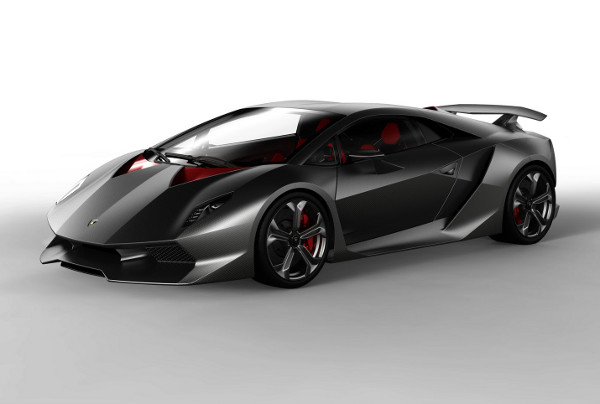
Lamborghini Sesto Elemento

Sports car manufacturer, Lamborghini is ready to make a breakthrough in September to introduce a new sports car. Lamborghini is not saying, but the news last blow that car was the Lamborghini Sesto Elemento.
According to the plan, Lamborghini will introduce a super sports car mat Tuesday at the Frankfurt Motor Show which opens on September 13, as quoted from leftlanenews next Wednesday (08/03/2011).


Lamborghini Sesto Elemento which is the production version will be introduced after the concept version shown at the auto show Paris Motor Show in 2010.
This car merupaka a very special car. For the Lamborghini Sesto Elemento using carbon fiber materials for the entire material. Sesto Elemento own name seems to refer to the number of carbon atoms of the element which is the figure 6 (Sixth Element).
By using the carbon fiber body weight of the car becomes very light which is only 999 kg. Super lightweight body is also a benefit for the speed enthusiast.
Due to the lightweight body, boost a typical malignant Lamborghini engine capable of carrying Sesto Elemento ran 0-100 km / h in just 2.5 seconds, with a maximum speed reaches 354 km / hour.


Ability is obtained from the ear of a capacity of 5.2 liter V10 engine that reportedly will strengthen the kitchen of this Italian car racing. This machine has a power of 560 horsepower.
Reportedly, this car will be produced only in very limited quantities of 20 units only. And because the specifications are almost perfectly with the amount of production very limited, it is no wonder that most likely the price of this car will greatly deplete the pockets of the millionaires. Chances are, Lamborghini Sesto Elemento be released at a price range of U.S. $ 2.9 million
When it does occur, then even this super-fast car will asked as the world's most expensive car the Bugatti Veyron to get rid of the crown which currently has it.
Because the numbers are slightly more expensive than the Bugatti Veyron's price tag is removed from the 1.45 million pounds or approximately up to 1.62 million pounds

Sunday, July 31, 2011

BMW X3 xDrive35i

In this 2011 BMW car manufacturer officially launched a new variant was named BMW X3 xDrive35i with six-cylinder inline engine gasoline. This variant is included in the class of SUVs (sports utility vehicle). Meanwhile, another variant is the BMW X3 xDrive20d engined four cylinder in line diesel.
By all appearances, this second generation of the BMW X3 comes with urban-style body design elegant and the view that gagah.BMW X3 xDrive uses a capacity of 3000 cc engine that can generate power to 306 hp at 58.00 rpm and maximum torque of 400 Nm at engine speed between 1200 and 5000 rpm.
While the BMW X3 xDrive20d using turbo four-cylinder diesel engine in line with a capacity of 2,000 cc which is made of aluminum and equipped with common rail direct injection. This machine is capable of spraying power up to 184 hp at 4,000 rpm rotation and a maximum torque of 380 nm in 1750 and 2,750 rpm.

Fresh from the redesign of the exterior and a good stretch, 2011 BMW X3 xDrive35i looks more bold and offer more space for people and goods. Yet deep inside an off-camber switchback mountain, it is to convince you That it's just a tall sports sedan. And no longer hits the contents of your loose to PROVE it.
As before, the standard all-wheel drive ensures That the 2011 BMW X3 xDrive35i earnest climb up the forest road with the first chairlift or the trailhead with ease - even if the most Difficult labor involved only draw Some Sea-Doos or Transporting a distance from Some Banana Republic for road construction.
But the 2011 BMW X3 xDrive35i driving every day cans be annoying, slow throttle response interfere with low-speed character in city driving. The Acura RDX, Audi Q5, Infiniti EX35 and Mercedes-Benz GLK350 all offer a more direct connection to the drivetrain and performance, making it more intuitive.
Given an open road and heads began to roll, but the BMW X3 Gives an exhilarating rush head.

BMW Z4

Combining classic proportions with modern sportiness, the new BMW Z4 has reached the top of its market segment almost overnight. And now this charismatic roadster is entering a new dimension in driving dynamics, the new BMW Z4 sDrive35is offering an even higher standard of performance ensured both by the modified straight-six power unit with BMW Twin Turbo Technology and High Precision Injection, on the one hand, and by BMW's seven-speed Sport Automatic with double clutch operation and the M Sports Package including the adaptive M Suspension likewise featured as standard, on the other. Appropriate optimisation in engine


technology increases maximum output of the 3.0-litre power unit to 250 kW/340 hp. Peak torque is 450 Newton-metres/332 lb-ft, increasing briefly with the Overboost function to 500 Newton-metres/369 lb-ft. The outstanding power and performance of the BMW Z4 sDrive35is is expressed in particular by the significant increase in pulling power and muscle to be clearly experienced in all situations. In conjunction with seven-speed Sport Automatic featuring double clutch operation, this new top-of-the-range