Launched in Europe in 1996, the Subaru Outback pioneered the 'Crossover' concept, combining the comfort, interior space and superior on-road handling of a family estate, with the off-road capability and ground clearance of a sports utility vehicle. This special blend of abilities has now been further refined.
The new Subaru Outback is longer, wider and taller than the model it replaces. It is also more capable and more engaging to drive on-and off-road, and offers increased space and comfort for all occupants.
While it retains the bold, assured stance of its forebears, the new Outback boasts a distinctive new 'face'. There's a prominent grille which features Subaru's now-trademark 'wing' motif. This bold detailing, coupled with a pair of ultra-modern, three-dimensional headlamps, gives the go-anywhere vehicle a refined yet purposeful look.
In profile, the Subaru Outback's premium feel continues thanks to muscular, flared wheel arches, standard-fit 17-inch alloys, and a chrome-framed glass-house. Its roofline sweeps towards the rear, where it meets new body-coloured D-pillars.
On the inside, you'll find a sophisticated interior design that perfectly complements the new Subaru Outback's subtly muscular exterior lines. Subaru's design team focused heavily on producing a feeling of spaciousness and quality and, thanks to several improvements such as increased seat adjustability, softer cushioning and reductions in NVH levels, the Subaru Outback's cabin is an even more luxurious and cosseting place in which to travel.
Showing posts with label nissan. Show all posts
Saturday, September 24, 2011
Monday, September 12, 2011
Yamaha YZF-R6 MotoGP-style dress
Yamaha has prepared four models to celebrate the 50th anniversary of participation in Grand Prix racing. One model is the YZF-R6. Capacity of 600 cc sport bike will get new clothes as worn motor Jorge Lorenzo and Ben Spies in action in the MotoGP championship at Laguna Seca and Assen series. So what possessed this bike, let us look further.
So strong sporty aura emanating from the self-R6. The corners are so sharp that menginsyaratkan aggressiveness seen in this bike. This is manifested in the fender, headlamp covers, fairing up to the stern. Display R6 with these new clothes can definitely be more in character. Moreover R6 into one of Yamaha's flagship product class middle-class motorsport.
In order, R6 deltabox reinforced aluminum chassis that offers a perfect balance so nimble and light when in use. This chassis where the Yamaha MotoGP inspired innovation called Straight Frame Concept.
To improve the driving comfort of course must have a quality suspension. Sector shock front upright and upside-down 43mm shock Monocross behind to conquer the vibrations or shocks when crossing bumpy road.
Braking system, R6 uses dual 310mm discs are clamped by four-piston calipers for the front Brembo alerts. While the rear uses 220mm discs with single piston calipers.
Yamaha R6 16-valve DOHC engine relies on four cylinders in line with a capacity of 599cc liquid cooling. By using a valve made from titanium famous lightweight but strong, so capable of producing tremendous power. These machines will be coupled with a six-speed transmission.
Maximizing the exhaust of combustion in the chamber pacemaker kitchen, bearing manufacturer features the Yamaha tuning fork EXUP System (Exhaust Ultimate Power Valve) are pinned on the exhaust is made from titanium. The system is able to eliminate empty spaces so that power can be fully charged and are also able to suppress exhaust emissions
So strong sporty aura emanating from the self-R6. The corners are so sharp that menginsyaratkan aggressiveness seen in this bike. This is manifested in the fender, headlamp covers, fairing up to the stern. Display R6 with these new clothes can definitely be more in character. Moreover R6 into one of Yamaha's flagship product class middle-class motorsport.
In order, R6 deltabox reinforced aluminum chassis that offers a perfect balance so nimble and light when in use. This chassis where the Yamaha MotoGP inspired innovation called Straight Frame Concept.
To improve the driving comfort of course must have a quality suspension. Sector shock front upright and upside-down 43mm shock Monocross behind to conquer the vibrations or shocks when crossing bumpy road.
Braking system, R6 uses dual 310mm discs are clamped by four-piston calipers for the front Brembo alerts. While the rear uses 220mm discs with single piston calipers.
Yamaha R6 16-valve DOHC engine relies on four cylinders in line with a capacity of 599cc liquid cooling. By using a valve made from titanium famous lightweight but strong, so capable of producing tremendous power. These machines will be coupled with a six-speed transmission.
Maximizing the exhaust of combustion in the chamber pacemaker kitchen, bearing manufacturer features the Yamaha tuning fork EXUP System (Exhaust Ultimate Power Valve) are pinned on the exhaust is made from titanium. The system is able to eliminate empty spaces so that power can be fully charged and are also able to suppress exhaust emissions
Friday, August 12, 2011
Kia Naimo electric concept
Making its world premiere at the Seoul Motor Show, the Kia Naimo electric concept car combines Korean heritage with innovative modern features.
Taking its name from the Korean word “Ne-mo”, (pronounced ‘Neh-mo’, meaning ‘square shape’), the KIA Naimo electric crossover utility vehicle (CUV) was conceived by Kia’s international design team in Seoul, and is characterized principally by its simple lines and solid, muscular stance.
The uncomplicated overall design is accentuated by a number of striking key details, such as the wraparound windscreen and asymmetric sunroof design, and the front and rear dot-style LED head- and positioning-lamps. Asian Celadon-style pottery, in particular, was a major influence on the car’s styling – with the pottery’s asymmetric form lending itself to the sunroof design, and the typical jade coloring giving Naimo its unique exterior finish.
Kia’s design team also made use of innovative technology features to give the KIA Naimo a premium feel and to ensure the car’s exterior remained uncluttered. For example, KIA Naimo has no traditional wiper blade on the windscreen – instead it employs a high-intensity air jet at the base of the windscreen that performs an ‘air wiper’ function. Conventional door mirrors have also been replaced with miniature cameras installed in the A-pillars.
KIA Naimo’s interior was designed to evoke a strong sense of tranquility and features hand-crafted materials throughout. Korean oak is used to trim the interior door panels and the entire interior floor, Korean “Han-ji” paper is used for the head lining. Alongside these traditional elements sit modern features such as a TOLED (transparent organic light emitting diode) storming display instrument panel and full device connectivity.
Measuring 3,890 mm in length, the KIA Naimo’s generous wheelbase, width and height (2,647, 1,844 and 1,589 mm respectively) – plus the short overhangs which place a wheel at each corner – ensure that the cabin provides exceptional head, leg and shoulder room for the occupants.
The KIA Naimo concept car has no B-pillars and features rear-hinged rear doors to maximize easy access to the cabin, and a three-way split opening trunk, allows versatile access to the load bay for varying luggage sizes.
Power comes from a PMSM (Permanent Magnet Synchronous Motor) electric motor with a maximum output of 80 kW (109 ps) and maximum torque of 280 Nm, enabling KIA Naimo to reach a top speed of 150 kph (93 mph).
A twin-pack 27 kWh battery is located under the trunk floor and uses innovative LiPoly (Lithium Ion Polymer) technology that offers numerous advantages over other battery types. Equipped with this battery, the KIA Naimo provides a driving range of 200 km (124 miles) on a single charge. To enhance range, the showcar is fitted with special low-drag 20-inch diameter alloy wheels.
Under the quick recharging cycle (50 kW) the KIA Naimo’s battery can be recharged to 80 percent of its capacity within 25 minutes. Under the normal cycle (3.3 kW), 100 percent power is attained after five and a half hours.
Taking its name from the Korean word “Ne-mo”, (pronounced ‘Neh-mo’, meaning ‘square shape’), the KIA Naimo electric crossover utility vehicle (CUV) was conceived by Kia’s international design team in Seoul, and is characterized principally by its simple lines and solid, muscular stance.
The uncomplicated overall design is accentuated by a number of striking key details, such as the wraparound windscreen and asymmetric sunroof design, and the front and rear dot-style LED head- and positioning-lamps. Asian Celadon-style pottery, in particular, was a major influence on the car’s styling – with the pottery’s asymmetric form lending itself to the sunroof design, and the typical jade coloring giving Naimo its unique exterior finish.
Kia’s design team also made use of innovative technology features to give the KIA Naimo a premium feel and to ensure the car’s exterior remained uncluttered. For example, KIA Naimo has no traditional wiper blade on the windscreen – instead it employs a high-intensity air jet at the base of the windscreen that performs an ‘air wiper’ function. Conventional door mirrors have also been replaced with miniature cameras installed in the A-pillars.
KIA Naimo’s interior was designed to evoke a strong sense of tranquility and features hand-crafted materials throughout. Korean oak is used to trim the interior door panels and the entire interior floor, Korean “Han-ji” paper is used for the head lining. Alongside these traditional elements sit modern features such as a TOLED (transparent organic light emitting diode) storming display instrument panel and full device connectivity.
Measuring 3,890 mm in length, the KIA Naimo’s generous wheelbase, width and height (2,647, 1,844 and 1,589 mm respectively) – plus the short overhangs which place a wheel at each corner – ensure that the cabin provides exceptional head, leg and shoulder room for the occupants.
The KIA Naimo concept car has no B-pillars and features rear-hinged rear doors to maximize easy access to the cabin, and a three-way split opening trunk, allows versatile access to the load bay for varying luggage sizes.
Power comes from a PMSM (Permanent Magnet Synchronous Motor) electric motor with a maximum output of 80 kW (109 ps) and maximum torque of 280 Nm, enabling KIA Naimo to reach a top speed of 150 kph (93 mph).
A twin-pack 27 kWh battery is located under the trunk floor and uses innovative LiPoly (Lithium Ion Polymer) technology that offers numerous advantages over other battery types. Equipped with this battery, the KIA Naimo provides a driving range of 200 km (124 miles) on a single charge. To enhance range, the showcar is fitted with special low-drag 20-inch diameter alloy wheels.
Under the quick recharging cycle (50 kW) the KIA Naimo’s battery can be recharged to 80 percent of its capacity within 25 minutes. Under the normal cycle (3.3 kW), 100 percent power is attained after five and a half hours.
2012 Ford Blue Angels Mustang GT
The Ford Blue Angels Mustang GT pays tribute to 100 years of naval aviation, which will be celebrated all week at AirVenture 2011 as part of the show’s Tier 1 event status from the U.S. Navy tied to its yearlong Centennial of Naval Aviation festivities. The car will be on display inside the Ford Hangar throughout EAA AirVenture.
The exterior of Ford’s Blue Angels Mustang GT was inspired by the acclaimed naval aviation performance demonstration team and the F-18 Hornet aircraft it flies. The car’s custom rear spoiler’s vertical tailfins, the “screaming yellow” gloss accents, inclusion of the Blue Angels script and crest all are drawn from the Navy aircraft. The unique chrome blue paint, courtesy of Creations n’ Chrome, is unlike anything available on a production vehicle anywhere in the world.
With the Blue Angels crest stitched into its leather Recaro racing seats, the car’s interior also features offset stripes inspired by pilot flight suits.
Additional unique details of the Ford Blue Angels Mustang GT include cluster graphics, performance gauges, navigation screen images, safety belt fabric, instrument panel appliqués, rear seat-delete and cross-brace,
Blue Angels script in the illuminated sill plates and puddle lamps that project jet images when the doors open.
Under the hood, the Ford Blue Angels Mustang GT is all performance with a Ford Racing supercharged 5.0-liter V8 engine producing 624 horsepower. The Ford Racing components also include a handling pack, performance exhaust and racetrack brakes.
The exterior of Ford’s Blue Angels Mustang GT was inspired by the acclaimed naval aviation performance demonstration team and the F-18 Hornet aircraft it flies. The car’s custom rear spoiler’s vertical tailfins, the “screaming yellow” gloss accents, inclusion of the Blue Angels script and crest all are drawn from the Navy aircraft. The unique chrome blue paint, courtesy of Creations n’ Chrome, is unlike anything available on a production vehicle anywhere in the world.
With the Blue Angels crest stitched into its leather Recaro racing seats, the car’s interior also features offset stripes inspired by pilot flight suits.
Additional unique details of the Ford Blue Angels Mustang GT include cluster graphics, performance gauges, navigation screen images, safety belt fabric, instrument panel appliqués, rear seat-delete and cross-brace,
Blue Angels script in the illuminated sill plates and puddle lamps that project jet images when the doors open.
Under the hood, the Ford Blue Angels Mustang GT is all performance with a Ford Racing supercharged 5.0-liter V8 engine producing 624 horsepower. The Ford Racing components also include a handling pack, performance exhaust and racetrack brakes.
2012 Ford Focus Studio
The new Ford Focus Studio extends the all-new Ford Focus range to five series, with prices from £13,995 for the Focus Studio to £24,000 the top-of-the-range Titanium X with six-speed Powershift automatic transmission and 163PS TDCi engine.
This newcomer replaces the popular Ford Focus Sport, a final special edition of the previous model which has been on sale since October 2010 and reached sales of 15,000.
Nigel Sharp, Ford of Britain managing director, said: “With the high end of the new Focus range fully established, we are now making it easier for customers to get behind the wheel at the entry level – and this new Ford Focus Studio model is not only affordable but it is also well equipped, attractive and economical too.”
Standard equipment on the all-new Ford Focus Studio includes 16in sports-style alloy wheels, body-coloured rear spoiler, radio/CD player, USB connectivity, air-conditioning, electrically-operated body-coloured door mirrors with integrated turn indicators, electrically-operated front windows, Ford Easy Fuel ‘capless’ refuelling, and Electronic Stability Programme (ESP) with torque vectoring control.
The Ford Focus Studio will be offered as a five-door hatchback with 85PS 1.6 Ti-VCT powertrain, delivering a fuel efficient 47.9mpg. There will be three colour choices – Panther Black, Moondust Silver and Frozen White.
This newcomer replaces the popular Ford Focus Sport, a final special edition of the previous model which has been on sale since October 2010 and reached sales of 15,000.
Nigel Sharp, Ford of Britain managing director, said: “With the high end of the new Focus range fully established, we are now making it easier for customers to get behind the wheel at the entry level – and this new Ford Focus Studio model is not only affordable but it is also well equipped, attractive and economical too.”
Standard equipment on the all-new Ford Focus Studio includes 16in sports-style alloy wheels, body-coloured rear spoiler, radio/CD player, USB connectivity, air-conditioning, electrically-operated body-coloured door mirrors with integrated turn indicators, electrically-operated front windows, Ford Easy Fuel ‘capless’ refuelling, and Electronic Stability Programme (ESP) with torque vectoring control.
The Ford Focus Studio will be offered as a five-door hatchback with 85PS 1.6 Ti-VCT powertrain, delivering a fuel efficient 47.9mpg. There will be three colour choices – Panther Black, Moondust Silver and Frozen White.
Monday, August 8, 2011
2011 Anderson Germany Ferrari F430 Scuderia Spider 16M
ANDERSON Germany transformed Ferrari
The performance of Ferrari Scuderia increase from 490 to now 569 hp resulted partly from a software optimization and from the exhaust system which, among other things, includes Renn-Kats and modified headers. And a three-level remote adjustable racing damper control is used as well. The weight savings achieved in this way were 29 kg; a rise of at least 38 hp as well as the special heat protection has positively influenced both security and performance.
The crew of the ANDERSON Germany equipped the Ferrari Scuderia with a set of three-piece glossy black wheels with carbon and yellow border and 20-inch 235er tires at the front and 325er – at the rear axle. The sport suspension is understandably in reasonable limits. The yellow brake caliper paint and window tinting still require a special mention.
The entire interior finishing was carried out with carbon black leather and Alcantara of the same color and yellow diamond Kederrand seams. The carbon package for the interior is in turn draws attention to the steering wheel, door handles, doorsill plates, handbrake lever and shift paddles. Sometimes one can mute the sound system with a DVD, a subwoofer and an amplifier and listen to the sound of the engine unit in silence…
Scuderia Spider 16M Conversion Edition through the exclusive reconstruction, which includes a front air dam, side skirts, a rear apron and adjustment of the exhaust system.
The bodywork was fitted with a black paint finish called Hyper Black. The Ferrari Scuderia Stripes are in carbon steel with a yellow border. A tint on front and rear lights is not unseen. The exterior carbon package includes an engine grille, a rear diffuser, mirrors and covers under the hood.
The performance of Ferrari Scuderia increase from 490 to now 569 hp resulted partly from a software optimization and from the exhaust system which, among other things, includes Renn-Kats and modified headers. And a three-level remote adjustable racing damper control is used as well. The weight savings achieved in this way were 29 kg; a rise of at least 38 hp as well as the special heat protection has positively influenced both security and performance.
The crew of the ANDERSON Germany equipped the Ferrari Scuderia with a set of three-piece glossy black wheels with carbon and yellow border and 20-inch 235er tires at the front and 325er – at the rear axle. The sport suspension is understandably in reasonable limits. The yellow brake caliper paint and window tinting still require a special mention.
The entire interior finishing was carried out with carbon black leather and Alcantara of the same color and yellow diamond Kederrand seams. The carbon package for the interior is in turn draws attention to the steering wheel, door handles, doorsill plates, handbrake lever and shift paddles. Sometimes one can mute the sound system with a DVD, a subwoofer and an amplifier and listen to the sound of the engine unit in silence…
Scuderia Spider 16M Conversion Edition through the exclusive reconstruction, which includes a front air dam, side skirts, a rear apron and adjustment of the exhaust system.
The bodywork was fitted with a black paint finish called Hyper Black. The Ferrari Scuderia Stripes are in carbon steel with a yellow border. A tint on front and rear lights is not unseen. The exterior carbon package includes an engine grille, a rear diffuser, mirrors and covers under the hood.
2011 Nissan 370Z GT Edition
The Nissan 370Z GT Edition recognises its heritage with a nod to the 1970s and the birth of the original Z car: special side stripes.
Grey ‘GT’ stripes running along the flanks of the car contrast with the each of the special edition’s three body colours – metallic black, pearl white and Black Rose, the latter shade exclusive to Nissan 370Z GT Edition. The exterior is set off by the standard 19inch RAYS forged alloy wheels, which are finished in a dramatic anthracite colour.
The Nissan 307Z GT Edition introduces a number of significant suspension and equipment improvements which have also been adopted by the standard Coupé. In deference to the higher average speeds routinely enjoyed in Europe, the changes have been engineered by technicians from Nissan Technical Centre Europe (NTCE). The principal modification has been to retune the dampers to provide the ideal balance between ride comfort and high-speed handling.
Equipment changes include the arrival of a rear view parking camera as part of the Nissan Premium Connect satellite navigation option and the standard fitment of a tyre pressure monitoring system. The advanced seven-speed automatic option now has a snow mode which, when applied, sets the car off in second gear and controls engine revs to prevent wheel spin on ice or snow. Refinement is enhanced by revisions to underbody insulation to reduce road noise.
Unchanged is the Nissan 370Z’s exceptional 3.7-litre V6 engine. A development of the unit that powered the 350Z, the all-alloy 24-valve twin cam not only develops more power and torque but is also more response, more refined and more fuel efficient.
The addition of VVEL (Variable Valve Event and Lift) technology helps deliver electrifying performance, the engine developing 328PS and an impressive 363Nm of torque. It is coupled to a short throw six-speed sports manual gearbox or a seven-speed automatic.
When in S-Mode, the manual transmission features Nissan’s Synchro Rev Control to ensures perfect rev matching when the driver is changing gear, delivering perfect ‘heel and toe’ changes every time.
Sensors on the clutch and on the gear lever itself monitor driver actions to blip the throttle on down shifts and maintain constant engine revs when changing up. As the sensors detect clutch pedal movement, the SRC system is primed, coming into operation when the gear lever is moved. By matching this information to vehicle speed, SRC knows whether the driver is slowing for a corner or changing up through the ‘box.
Downshift Rev Matching is a feature on the automatic gearbox, too, which also has Adaptive Shift Control which learns a driving style and adjust shift patterns accordingly.
The Nissan 370Z’s chassis is a car enthusiast’s dream: double wishbone front suspension and a multi-link rear end makes the most of Nissan’s agile FM (Front Midships) rear-drive platform.
With a shorter wheelbase, wider track and stiffer shell than its predecessor, the 370Z has starred on track as well as on road. The innovative GT Academy programme takes computer gamers who have become Gran Turismo experts on PlayStation 3 and turns them into real race drivers. Now in its third season, winners will again race for a place on the grid in a GT4 race prepared 370Z at the Dubai 24 hours in January 2012 and, perhaps, on to the GT pinnacle, GT1.
Grey ‘GT’ stripes running along the flanks of the car contrast with the each of the special edition’s three body colours – metallic black, pearl white and Black Rose, the latter shade exclusive to Nissan 370Z GT Edition. The exterior is set off by the standard 19inch RAYS forged alloy wheels, which are finished in a dramatic anthracite colour.
The Nissan 307Z GT Edition introduces a number of significant suspension and equipment improvements which have also been adopted by the standard Coupé. In deference to the higher average speeds routinely enjoyed in Europe, the changes have been engineered by technicians from Nissan Technical Centre Europe (NTCE). The principal modification has been to retune the dampers to provide the ideal balance between ride comfort and high-speed handling.
Equipment changes include the arrival of a rear view parking camera as part of the Nissan Premium Connect satellite navigation option and the standard fitment of a tyre pressure monitoring system. The advanced seven-speed automatic option now has a snow mode which, when applied, sets the car off in second gear and controls engine revs to prevent wheel spin on ice or snow. Refinement is enhanced by revisions to underbody insulation to reduce road noise.
Unchanged is the Nissan 370Z’s exceptional 3.7-litre V6 engine. A development of the unit that powered the 350Z, the all-alloy 24-valve twin cam not only develops more power and torque but is also more response, more refined and more fuel efficient.
The addition of VVEL (Variable Valve Event and Lift) technology helps deliver electrifying performance, the engine developing 328PS and an impressive 363Nm of torque. It is coupled to a short throw six-speed sports manual gearbox or a seven-speed automatic.
When in S-Mode, the manual transmission features Nissan’s Synchro Rev Control to ensures perfect rev matching when the driver is changing gear, delivering perfect ‘heel and toe’ changes every time.
Sensors on the clutch and on the gear lever itself monitor driver actions to blip the throttle on down shifts and maintain constant engine revs when changing up. As the sensors detect clutch pedal movement, the SRC system is primed, coming into operation when the gear lever is moved. By matching this information to vehicle speed, SRC knows whether the driver is slowing for a corner or changing up through the ‘box.
Downshift Rev Matching is a feature on the automatic gearbox, too, which also has Adaptive Shift Control which learns a driving style and adjust shift patterns accordingly.
The Nissan 370Z’s chassis is a car enthusiast’s dream: double wishbone front suspension and a multi-link rear end makes the most of Nissan’s agile FM (Front Midships) rear-drive platform.
With a shorter wheelbase, wider track and stiffer shell than its predecessor, the 370Z has starred on track as well as on road. The innovative GT Academy programme takes computer gamers who have become Gran Turismo experts on PlayStation 3 and turns them into real race drivers. Now in its third season, winners will again race for a place on the grid in a GT4 race prepared 370Z at the Dubai 24 hours in January 2012 and, perhaps, on to the GT pinnacle, GT1.
2011 Nissan 370Z Roadster
By starting design of the 2011 Nissan 370Z Roadster
When lowered, it tucks away under a body-coloured hard tonneau cover which also helps to reduce wind turbulence at speed, allowing occupants of the ‘double cockpit’ to enjoy fully the sounds and sensations of open air performance motoring.
Other design cues already seen on the Nissan 370Z Coupe have transferred to the Roadster. They include the distinctive boomerang LED rear and arrowhead front lights, while familiar ‘Z’ features such as the vertical door handles, twin tail pipes and ‘Z’ badges in the side repeaters are also present.
Inside the Nissan 370Z Roadster, the driver-focused cabin also boasts many features now synonymous with the Z, such as an engine Push Start button, floor hinged throttle pedal, centrally placed tachometer and three separate hooded dials – now including an oil temperature gauge – sitting centrally on the top of the dashboard and angled towards the driver.
The Nissan 370Z Roadster’s roof is fully automatic with no requirement to latch it manually into place. The roof can be lowered at walking speeds and can also be operated from outside the car, by pressing and holding the door-locking button for three seconds. It takes just 20 seconds for the roof to be raised and locked into place or lowered out of sight beneath its tonneau.
The fabric hood has been given a smooth inner lining covering the frame and reducing noise levels, while the system uses a new hydraulic pump that’s silent in operation in place of the electric motor used previously.
“At launch, both the Coupé and Roadster were highly acclaimed for their combination of excitement and style. The subtle suspension changes developed specially to meet European demands and tastes – not to mention the enhanced equipment levels – make the 2011 370Z more desirable than ever,” said Thomas.
at the same time as work began on the Coupé, Nissan designers have been able to ensure the soft-top version has a sophisticated silhouette with better, more natural, integration of the hood into the overall design.
The distinctive result echoes the ‘Z character’ with a blend of sweeping curves and aggressively short overhangs while the shape of the roof itself flows more naturally into the rear of the car when the roof is in place.
When lowered, it tucks away under a body-coloured hard tonneau cover which also helps to reduce wind turbulence at speed, allowing occupants of the ‘double cockpit’ to enjoy fully the sounds and sensations of open air performance motoring.
Other design cues already seen on the Nissan 370Z Coupe have transferred to the Roadster. They include the distinctive boomerang LED rear and arrowhead front lights, while familiar ‘Z’ features such as the vertical door handles, twin tail pipes and ‘Z’ badges in the side repeaters are also present.
Inside the Nissan 370Z Roadster, the driver-focused cabin also boasts many features now synonymous with the Z, such as an engine Push Start button, floor hinged throttle pedal, centrally placed tachometer and three separate hooded dials – now including an oil temperature gauge – sitting centrally on the top of the dashboard and angled towards the driver.
The Nissan 370Z Roadster’s roof is fully automatic with no requirement to latch it manually into place. The roof can be lowered at walking speeds and can also be operated from outside the car, by pressing and holding the door-locking button for three seconds. It takes just 20 seconds for the roof to be raised and locked into place or lowered out of sight beneath its tonneau.
The fabric hood has been given a smooth inner lining covering the frame and reducing noise levels, while the system uses a new hydraulic pump that’s silent in operation in place of the electric motor used previously.
“At launch, both the Coupé and Roadster were highly acclaimed for their combination of excitement and style. The subtle suspension changes developed specially to meet European demands and tastes – not to mention the enhanced equipment levels – make the 2011 370Z more desirable than ever,” said Thomas.
at the same time as work began on the Coupé, Nissan designers have been able to ensure the soft-top version has a sophisticated silhouette with better, more natural, integration of the hood into the overall design.
The distinctive result echoes the ‘Z character’ with a blend of sweeping curves and aggressively short overhangs while the shape of the roof itself flows more naturally into the rear of the car when the roof is in place.
2012 Nissan Versa Hatchback
The 2012 Nissan Versa Hatchback is offered in 1.8 S and 1.8 SL models, each equipped with a 122-horsepower 1.8-liter DOHC 4-cylinder engine. The Nissan Versa Hatchback S is available with a choice of 6-speed manual or 4-speed automatic, while the Hatchback 1.8 SL is offered exclusively with Nissan’s advanced Xtronic CVT® transmission.
The 2012 Nissan Versa Hatchback long 102.4-inch wheelbase and short front and rear overhangs create a sporty dynamic look. The Versa Hatchback exterior also features body-color front and rear bumpers and body-color dual remote-controlled outside mirrors. Versa Hatchback has a coefficient of drag of 0.31. Versa Hatchback 1.8 SL models add a higher level of performance styling with a roof-mounted rear spoiler, lower body side sill extensions, unique front and rear fascia and standard fog lights.
The 2012 Nissan Versa Hatchback is available in nine exterior colors: Red Alert, Metallic Blue, Blue Onyx, Espresso Black, Brilliant Silver, Magnetic Gray, Super Black, Fresh Powder and Arctic Blue.
Every 2012 Nissan Versa Hatchback comes equipped with a standard 1.8-liter DOHC 4-cylinder engine rated at 122 horsepower and 127 lb-ft of torque. Three transmissions are offered – a 6-speed manual (1.8 S), an electronically controlled 4-speed automatic with overdrive (optional 1.8 S), and Xtronic CVT™ transmission (standard on 1.8 SL).
Fuel economy for the 2012 Nissan Versa Hatchback is rated at 28 mpg City/34 mpg Highway with the Continuously Variable Transmission; 24 mpg City/32 mpg highway with the 4-speed automatic transmission; and 26 mpg City/31 mpg Highway with the 6-speed manual transmission.
All 2012 Nissan Versa Hatchbacks are equipped with an independent MacPherson strut front suspension and torsion beam rear suspension, with front and rear stabilizer bars. Other standard equipment includes Electric Power Steering and power-assisted front disc/rear drum brakes and Anti-lock Braking System (ABS) with Electronic Brake force Distribution (EBD) and Brake Assist (BA). Vehicle Dynamic Control (VDC) is also standard.
Nissan Versa Hatchback 1.8 S models feature 15-inch styled steel wheels with covers and P185/65HR15 Continental all-season tires. Nissan Versa Hatchback 1.8 SL models offer standard 16-inch aluminum-alloy wheels with Continental P195/55R16 all-season tires, while 6-spoke 15-inch aluminum-alloy wheels are optional on 1.8 S models equipped with the 4-speed automatic transmission.
The 2012 Nissan Versa Hatchback is manufactured at Nissan’s Aguascalientes and Cuervanaca, Mexico assembly plants.
The 2012 Nissan Versa Hatchback long 102.4-inch wheelbase and short front and rear overhangs create a sporty dynamic look. The Versa Hatchback exterior also features body-color front and rear bumpers and body-color dual remote-controlled outside mirrors. Versa Hatchback has a coefficient of drag of 0.31. Versa Hatchback 1.8 SL models add a higher level of performance styling with a roof-mounted rear spoiler, lower body side sill extensions, unique front and rear fascia and standard fog lights.
The 2012 Nissan Versa Hatchback is available in nine exterior colors: Red Alert, Metallic Blue, Blue Onyx, Espresso Black, Brilliant Silver, Magnetic Gray, Super Black, Fresh Powder and Arctic Blue.
Every 2012 Nissan Versa Hatchback comes equipped with a standard 1.8-liter DOHC 4-cylinder engine rated at 122 horsepower and 127 lb-ft of torque. Three transmissions are offered – a 6-speed manual (1.8 S), an electronically controlled 4-speed automatic with overdrive (optional 1.8 S), and Xtronic CVT™ transmission (standard on 1.8 SL).
Fuel economy for the 2012 Nissan Versa Hatchback is rated at 28 mpg City/34 mpg Highway with the Continuously Variable Transmission; 24 mpg City/32 mpg highway with the 4-speed automatic transmission; and 26 mpg City/31 mpg Highway with the 6-speed manual transmission.
All 2012 Nissan Versa Hatchbacks are equipped with an independent MacPherson strut front suspension and torsion beam rear suspension, with front and rear stabilizer bars. Other standard equipment includes Electric Power Steering and power-assisted front disc/rear drum brakes and Anti-lock Braking System (ABS) with Electronic Brake force Distribution (EBD) and Brake Assist (BA). Vehicle Dynamic Control (VDC) is also standard.
Nissan Versa Hatchback 1.8 S models feature 15-inch styled steel wheels with covers and P185/65HR15 Continental all-season tires. Nissan Versa Hatchback 1.8 SL models offer standard 16-inch aluminum-alloy wheels with Continental P195/55R16 all-season tires, while 6-spoke 15-inch aluminum-alloy wheels are optional on 1.8 S models equipped with the 4-speed automatic transmission.
The 2012 Nissan Versa Hatchback is manufactured at Nissan’s Aguascalientes and Cuervanaca, Mexico assembly plants.
Nissan Micra DIG-S
Nissan Micra DIG-S. Powering the newest version of the popular Nissan Micra city car – the DIG-S – this advanced petrol engine produces just 95 g CO2/km and underlines Nissan’s leadership in both zero and low emissions mobility.
A direct injection unit with a supercharger – hence the car’s name: Direct Injection Gasoline-Supercharger (DIG-S) – the engine is the embodiment of Nissan’s PURE DRIVE strategy, delivering sparkling performance, frugal economy and exceptionally low emissions.
Technical innovation has been packed into the engine. The Nissan DIG-S uses the Miller cycle and direct petrol injection to raise the compression ratio to 13 to 1 for greater combustion efficiency and a supercharger for instant throttle response and added power. As well as delivering ultra low CO2 emissions, the lightweight, low-friction 1,198cc three-cylinder unit produces the power expected from a conventional 1.5-litre four-cylinder engine.
Nissan Micra’s city car credentials have been honed over decades of class leading models. Bristling with new technologies and based on a brand new platform, Europe-bound examples of the fourth generation Nissan Micra are built at an entirely new facility in India. It is also built in China, Mexico and Thailand and is sold in 160 countries around the world.
The new Nissan Micra DIG-S is available in one body five-door body style, three trim levels – Visia, Acenta and Tekna – and with a choice of two petrol engines. As well as the DIG-S, there’s a normally aspirated version of the 1.2-litre engine, developing 59kW (80PS).
By minimising heat, friction and pumping losses as much a possible, Nissan’s engineers have created an engine that sets the standard for the rest of the industry. Its three-cylinder configuration gives many benefits including less weight and further reductions in friction loss, thanks to having fewer moving parts. Further gains are made thanks to the adoption of advanced engine management systems with Start/Stop and energy regeneration.
The Direct Injection Gasoline-Supercharger (DIG-S) engine produces 72kW (98PS) and 142Nm, while CO2 emissions are 95 g/km for the manual version and 115 g/km for the CVT version. Maximum speed is 180km/h for manual. Combined cycle fuel economy figures for the manual Visia version is 4.1 l/100kmh *.
In common with industry practice, these headline figures refer to the entry-level version – Visia – as higher levels of equipment found in plusher models mean extra weight which affects emissions performance. But such is the efficiency of the unit that the most popular version, Acenta, also promises an outstanding CO2 figure: just 99 g/km in manual form.
This remarkable engine makes sub 100 g/km emissions performance easily accessible while low cost of ownership make it a serious alternative to a comparable diesel… with the added bonus of greater refinement. Its first appearance powering the new Nissan Micra makes for an irresistible combination.
A direct injection unit with a supercharger – hence the car’s name: Direct Injection Gasoline-Supercharger (DIG-S) – the engine is the embodiment of Nissan’s PURE DRIVE strategy, delivering sparkling performance, frugal economy and exceptionally low emissions.
Technical innovation has been packed into the engine. The Nissan DIG-S uses the Miller cycle and direct petrol injection to raise the compression ratio to 13 to 1 for greater combustion efficiency and a supercharger for instant throttle response and added power. As well as delivering ultra low CO2 emissions, the lightweight, low-friction 1,198cc three-cylinder unit produces the power expected from a conventional 1.5-litre four-cylinder engine.
Nissan Micra’s city car credentials have been honed over decades of class leading models. Bristling with new technologies and based on a brand new platform, Europe-bound examples of the fourth generation Nissan Micra are built at an entirely new facility in India. It is also built in China, Mexico and Thailand and is sold in 160 countries around the world.
The new Nissan Micra DIG-S is available in one body five-door body style, three trim levels – Visia, Acenta and Tekna – and with a choice of two petrol engines. As well as the DIG-S, there’s a normally aspirated version of the 1.2-litre engine, developing 59kW (80PS).
By minimising heat, friction and pumping losses as much a possible, Nissan’s engineers have created an engine that sets the standard for the rest of the industry. Its three-cylinder configuration gives many benefits including less weight and further reductions in friction loss, thanks to having fewer moving parts. Further gains are made thanks to the adoption of advanced engine management systems with Start/Stop and energy regeneration.
The Direct Injection Gasoline-Supercharger (DIG-S) engine produces 72kW (98PS) and 142Nm, while CO2 emissions are 95 g/km for the manual version and 115 g/km for the CVT version. Maximum speed is 180km/h for manual. Combined cycle fuel economy figures for the manual Visia version is 4.1 l/100kmh *.
In common with industry practice, these headline figures refer to the entry-level version – Visia – as higher levels of equipment found in plusher models mean extra weight which affects emissions performance. But such is the efficiency of the unit that the most popular version, Acenta, also promises an outstanding CO2 figure: just 99 g/km in manual form.
This remarkable engine makes sub 100 g/km emissions performance easily accessible while low cost of ownership make it a serious alternative to a comparable diesel… with the added bonus of greater refinement. Its first appearance powering the new Nissan Micra makes for an irresistible combination.
Nissan Sunny
Nissan Motor Co., Ltd. unveiled an all-new sedan model at the 8th China (Guangzhou) International Automobile Exhibition. Using the famed 'Sunny' name in China, this new model will go on sale first in China in January 2011 and then progressively across 170 countries worldwide under different vehicle brand names.
The Nissan Sunny was first introduced in China in 2003 and was significant as the first locally built model from the new Dongfeng Nissan partnership. Acclaimed by consumers for its combination of quality, space and driving performance, the Nissan Sunny quickly help establish a foundation for the Nissan brand in the passenger vehicle market in China.
A projected class leader in fuel economy, the all-new Nissan Sunny is expected to appeal to young families in their 30s looking for a medium sized sedan that combines a dynamic upscale design with the space, quality and features associated with the Sunny and Nissan brand.
Combining the proven Nissan 1.5-liter HR15DE engine with dual injectors and a new-generation Xtronic CVT with an auxiliary transmission, both of which are newly introduced in China, Nissan Sunny delivers ease in handling for city driving where there's frequent acceleration and deceleration, and superior environmental performance as a projected class leader in fuel economy.
MacPherson struts are used for the front suspension and a torsion beam for the rear suspension, making for sporty and agile driving at low speeds, and steady and stable driving at higher speeds.
The new Nissan Sunny will be produced in Dongfeng Nissan's Huadu Plant in Guangzhou and will be priced from RMB 82.8K to 112.8K (1.04 million - 1.41million yen).
At the 8th China (Guangzhou) International Automobile Exhibition, Nissan Motor Co., Ltd. unveiled an all-new sedan model “Sunny”. The Nissan Sunny was first introduced in China in 2003 and was significant as the first locally built model from the new Dongfeng Nissan partnership.
The all-new Nissan Sunny is expected to appeal to young families in their 30s looking for a medium sized sedan that combines a dynamic upscale design with the space, quality and features associated with the Sunny and Nissan brand. The 2012 model projected class leader in fuel economy.
The Nissan Sunny was first introduced in China in 2003 and was significant as the first locally built model from the new Dongfeng Nissan partnership. Acclaimed by consumers for its combination of quality, space and driving performance, the Nissan Sunny quickly help establish a foundation for the Nissan brand in the passenger vehicle market in China.
A projected class leader in fuel economy, the all-new Nissan Sunny is expected to appeal to young families in their 30s looking for a medium sized sedan that combines a dynamic upscale design with the space, quality and features associated with the Sunny and Nissan brand.
Combining the proven Nissan 1.5-liter HR15DE engine with dual injectors and a new-generation Xtronic CVT with an auxiliary transmission, both of which are newly introduced in China, Nissan Sunny delivers ease in handling for city driving where there's frequent acceleration and deceleration, and superior environmental performance as a projected class leader in fuel economy.
MacPherson struts are used for the front suspension and a torsion beam for the rear suspension, making for sporty and agile driving at low speeds, and steady and stable driving at higher speeds.
The new Nissan Sunny will be produced in Dongfeng Nissan's Huadu Plant in Guangzhou and will be priced from RMB 82.8K to 112.8K (1.04 million - 1.41million yen).
At the 8th China (Guangzhou) International Automobile Exhibition, Nissan Motor Co., Ltd. unveiled an all-new sedan model “Sunny”. The Nissan Sunny was first introduced in China in 2003 and was significant as the first locally built model from the new Dongfeng Nissan partnership.
The all-new Nissan Sunny is expected to appeal to young families in their 30s looking for a medium sized sedan that combines a dynamic upscale design with the space, quality and features associated with the Sunny and Nissan brand. The 2012 model projected class leader in fuel economy.
Nissan Versa Sedan
Compact sedans are all the rage, with a host of new entries from both domestic and import manufacturers reaching showrooms recently. Nissan will cash in on that popularity with the 2012 Versa sedan, debuting today at the New York auto show with refreshed styling and tweaks to improve fuel economy.
The 2012 Versa rides on an evolution of the last car's platform called V, for Versatile. The sedan's wheelbase and width are unchanged from the current model, but it loses about an inch of length and height. Despite this, Nissan says that packaging improvements for the engine and transaxle mean there is more trunk space. The new car also should be marginally lighter than before.
Styling-wise, the new Versa takes cues from the larger Altima and Maxima sedans, starting with a new grille design and oval-shaped headlights, and continued with a smoother rear and reshaped taillights that sweep from the rear bumper to the Versa's rear haunches. The hood and sides are broken up by an assortment of creased character lines akin to those seen on the Hyundai Elantra. Whereas the old Versa had a more conventional flat roof and steep rear window, the new car's roofline gently slopes toward the trunk, following the coupe-like trend. The exterior changes reportedly help achieve a low 0.31 drag coefficient.
Sunday, July 31, 2011
Nissan Tiida
Nissan Motor Co., Ltd. premiered an all-new hatchback model at the 2011 Auto Shanghai. This new model will be the new generation Nissan Tiida in China.
The Nissan Tiida hatchback, introduced in China in 2005 from Dongfeng Nissan, is a pioneer in the compact hatchback market in China, selling 85,000 units in 2010. Sold globally in 165 countries, the Nissan Tiida is the best-selling model in the current Nissan product lineup.
The all-new Nissan Tiida is targeted toward young families who value quality life. With appeal points such as 'premium and agile styling', 'class leading comfort' and 'PURE DRIVE revolutionary powertrain', the new model will continue to be a leading model in the compact hatchback market in China. Nissan will also be the first Japanese automaker to introduce a turbo-charged engine in the Chinese market, with the introduction of the new Tiida's turbo series.
Based on a keyword 'Fluid & Brisk', the new Nissan Tiida delivers a new, premium feeling with a smooth, streamlined bodyside, well-balanced proportions and advanced-design exterior parts, such as grilles and lamps with refined details. To further enhance its spacious interior, which has been well received in the previous generation Tiida hatchback, the wheelbase length has been increased by 100mm to ensure best-in-class rear knee room. With increased length and breadth of the front window and optimally-shaped side mirrors for ease of use, visibility is significantly improved contributing to stress-free driving.
Interior design is developed using another keyword - 'Calm & Refined'. With a comfortable interior to embrace the driver and passengers, an elegant and precisely-crafted meter, a floating center cluster, and wide, super-soft armrests, the car provides premium space offering comfortable feeling in driving.
Driving comfort is also realized by soft, comfortable seats with low vibration which brings about less fatigue during driving.
Installed is a reliable, easy-to-handle, fuel-efficient Nissan HR16DE engine which has been employed in a number of Nissan vehicles. In addition, a range of PURE DRIVE low-emission technologies has also been added, such as latest dual injectors that provides far greater combustion efficiency by finely splashing fuel and Xtronic CVT with an auxiliary transmission. Select models of the all-new Nissan Tiida fully meet the stringent third phase fuel-efficiency requirements in China (draft data issued in Nov. 2009).
This new model, to be produced in the Dongfeng Nissan Huadu Plant in Guangzhou, will be released in late May 2011. Followed by its introduction in China, it will be launched in approximately 130 countries around the world by 2014.
The Nissan Tiida hatchback, introduced in China in 2005 from Dongfeng Nissan, is a pioneer in the compact hatchback market in China, selling 85,000 units in 2010. Sold globally in 165 countries, the Nissan Tiida is the best-selling model in the current Nissan product lineup.
The all-new Nissan Tiida is targeted toward young families who value quality life. With appeal points such as 'premium and agile styling', 'class leading comfort' and 'PURE DRIVE revolutionary powertrain', the new model will continue to be a leading model in the compact hatchback market in China. Nissan will also be the first Japanese automaker to introduce a turbo-charged engine in the Chinese market, with the introduction of the new Tiida's turbo series.
Based on a keyword 'Fluid & Brisk', the new Nissan Tiida delivers a new, premium feeling with a smooth, streamlined bodyside, well-balanced proportions and advanced-design exterior parts, such as grilles and lamps with refined details. To further enhance its spacious interior, which has been well received in the previous generation Tiida hatchback, the wheelbase length has been increased by 100mm to ensure best-in-class rear knee room. With increased length and breadth of the front window and optimally-shaped side mirrors for ease of use, visibility is significantly improved contributing to stress-free driving.
Interior design is developed using another keyword - 'Calm & Refined'. With a comfortable interior to embrace the driver and passengers, an elegant and precisely-crafted meter, a floating center cluster, and wide, super-soft armrests, the car provides premium space offering comfortable feeling in driving.
Driving comfort is also realized by soft, comfortable seats with low vibration which brings about less fatigue during driving.
Installed is a reliable, easy-to-handle, fuel-efficient Nissan HR16DE engine which has been employed in a number of Nissan vehicles. In addition, a range of PURE DRIVE low-emission technologies has also been added, such as latest dual injectors that provides far greater combustion efficiency by finely splashing fuel and Xtronic CVT with an auxiliary transmission. Select models of the all-new Nissan Tiida fully meet the stringent third phase fuel-efficiency requirements in China (draft data issued in Nov. 2009).
This new model, to be produced in the Dongfeng Nissan Huadu Plant in Guangzhou, will be released in late May 2011. Followed by its introduction in China, it will be launched in approximately 130 countries around the world by 2014.
Nissan Patrol
Reliable, unbreakable, affordable. The Nissan Patrol is a name synonymous with ruggedness, a legendary off-roader capable of going anywhere, anytime. Meticulously honed for over five decades, the Patrol is Nissan's flagship large SUV model and enjoys a rich heritage particularly in the Middle East that dates back to the 1950's. This off-road trendsetter was one of the first dedicated four-wheel-drive vehicles in the climatically demanding Middle East region, and boasts the notable distinction of also being the first vehicle to successfully cross the grueling Simpson Desert in Australia back in 1962.
Under the banner of "The Hero Comes Home" the Nissan Patrol is back as an all-new seventh generation model, building on its impressive history, but at the same time, incorporating a new platform, a radical new design direction, significantly enhanced interior comfort and luxury, powerful new V8 engines, a 7-speed automatic transmission and a new 4WD system.
"We paid special attention to the needs of current Nissan Patrol owners, and their passengers, and so focused on creating first-class levels of comfort for the whole family. Heightened luxury, a roomier cabin and a quieter ride combine to achieve this goal, while maintaining Nissan Patrol's superior off-road heritage" stresses Hiroyuki Fushiki, project head and Segment Chief Product Specialist.
Tested to the limit
Wanting to build the best possible Nissan Patrol, engineers first tuned and tested 200 prototypes for dynamic evaluation at the company's Motegi, Oppama and Tochigi proving grounds before sending them to the Middle East where they were exposed to every imaginable challenge; desert, rocky surfaces, highways and inner-city traffic. "By the time we came around to adding the new body and interior, we had virtually completed our reliability and durability testing and perfected all of the new technologies," says chief vehicle engineer, Takashi Fukui.
After extensive market research, especially in the Middle East, the design team concluded that for the Nissan Patrol to beat its main competitors, it needed not only a brand new design direction but class-leading engine performance, greater luxury and comfort and a smart mix of new technologies that enhanced the total driving experience. Product design director, Taiji Toyota, tells us that the all-new exterior design is like a breath of fresh air. "Not as edgy and hardcore as its predecessor, the softer new surfaces are beautiful and add a sense of modernity to the design equation, while still maintaining a ruggedness and commanding road presence" he said.
According to the design director, one design element that expresses 'Patrol' and had to feature strongly was the angled-strut motif front grille. It was meticulously proportioned to deliver a sense of continuity with past models but give a touch of newness while enhancing the car's status level.
Focus on roomier, more luxurious cabin
Featuring generous amounts of leather, polished aluminium and wood grain paneling, the Nissan Patrol's interior too has been significantly upgraded. Given that most customers only go off-road no more than 15% of the time, designers wanted to create a better, higher quality interior for the whole family.
In keeping with the Nissan Patrol's mission to deliver more comfort and more room, the new Patrol delivers seat dimensions that outclass all competition. Boasting wider, higher and deeper front seats, the Nissan Patrol offers over 100mm more legroom for second row passengers, and a roomier third row of seats as well. Employing double the lateral rigidity over the outgoing model, the new Nissan Patrol sits on a revised platform that now offers a more robust construction with a low vibration body.
All-new V8 engine leads array of segment-beating hardware
The new Nissan Patrol is now the most powerful vehicle in its class. And the key technology achieving this jump in performance over the predecessor's 4.8 litre power plant is the newly developed 'VK56VD' 5.6-litre V8 engine with VVEL (variable valve event and lift) and DIG (direct injection gasoline) technologies that generate 400hp and 550Nm of torque on the top specification version of this new engine.
Every component has been redesigned for maximum performance and smooth response, while a new 7-speed automatic transmission with a wider range of gear ratios than its predecessor, gives the off-roader the ability to deliver power faster.
Comprehensively upgraded 4WD system sets new standard
In a world-first for Nissan, the new Patrol employs a Hydraulic Body Motion Control System (HBMC), which keeps the car flatter with less body roll during lane-changing and cornering, while delivering a comfortable ride in city driving and superb stability on rugged and sandy tracks. Another crucial part of handling equation comes from the new suspension system, which now employs 4-wheel independent suspension, upgraded from the previous rigid axle setup. Nissan has completely redesigned the vehicle's suspension from the bushes to the links. The combination of HBMC and the new suspension system with its longer suspension stroke delivers significantly improved handling and stability on both on- and off-road terrain.
The Nissan Patrol also employs a newly developed ALL MODE 4x4 system incorporating a variable 4x4 mode package. It allows the driver to quickly switch between four drive modes: sand, on-road, snow and rock, with the flick of a switch. In sand mode, owners are able to drive safely, quickly and skillfully in sand and dirt, just like professional rally drivers.
In addition, the Nissan Patrol also offers a new Hill Start Assist and Hill Descent Control which can also be selected easily with the touch of a button. With Hill Start Assist, if a driver stops on a slope and steps off the brake pedal, the system keeps the vehicle stationary - with no roll back. Hill Descent Control uses the brakes to maintain a constant downhill speed of 7km/h in 4H mode and 4km/h in 4L mode.
The new model employs a revised Tyre Pressure Monitor System (TPMS) with tyre inflation indicator which beeps the horn softly to inform drivers that a suitable tyre pressure has been reached.
A revised, more effective brake system also provides the best braking performance in its class thanks to its new hydraulic brake booster and a 4-piston opposed front caliper setup with larger 358mm front discs.
More world-firsts
Nissan designers paid special attention to the second row seat passengers by not only significantly expanding legroom, but by also fitting a new multi-screen DVD entertainment system, a first form Nissan. It boasts two rear-facing TVs; one 7-inch monitor embedded into each front seat headrest.
Fitted with six airbags for top grade, the Nissan Patrol also comes with a totally revised climate control system boasting another world-first - the curtain vent. Curtain vent has several small but highly effective vents mounted in the ceiling above each side window to blow a strong current of cool air down forming a curtain of air that acts as a barrier to heat penetrating the cabin.
Yet another impressive Nissan Patrol feature is the cool box mounted in the centre console between the front seats. Incorporating a unique double hinge design, the lid of the cool box can be opened easily from either the front or second row of seats to access the six 600ml drink bottles inside.
And lastly...
With its fresh new styling, superior packaging, powerful but economical V8 engine, clever off-road technologies and higher levels of luxury and comfort, the all-new Nissan Patrol is now a true segment leader.
Under the banner of "The Hero Comes Home" the Nissan Patrol is back as an all-new seventh generation model, building on its impressive history, but at the same time, incorporating a new platform, a radical new design direction, significantly enhanced interior comfort and luxury, powerful new V8 engines, a 7-speed automatic transmission and a new 4WD system.
"We paid special attention to the needs of current Nissan Patrol owners, and their passengers, and so focused on creating first-class levels of comfort for the whole family. Heightened luxury, a roomier cabin and a quieter ride combine to achieve this goal, while maintaining Nissan Patrol's superior off-road heritage" stresses Hiroyuki Fushiki, project head and Segment Chief Product Specialist.
Tested to the limit
Wanting to build the best possible Nissan Patrol, engineers first tuned and tested 200 prototypes for dynamic evaluation at the company's Motegi, Oppama and Tochigi proving grounds before sending them to the Middle East where they were exposed to every imaginable challenge; desert, rocky surfaces, highways and inner-city traffic. "By the time we came around to adding the new body and interior, we had virtually completed our reliability and durability testing and perfected all of the new technologies," says chief vehicle engineer, Takashi Fukui.
After extensive market research, especially in the Middle East, the design team concluded that for the Nissan Patrol to beat its main competitors, it needed not only a brand new design direction but class-leading engine performance, greater luxury and comfort and a smart mix of new technologies that enhanced the total driving experience. Product design director, Taiji Toyota, tells us that the all-new exterior design is like a breath of fresh air. "Not as edgy and hardcore as its predecessor, the softer new surfaces are beautiful and add a sense of modernity to the design equation, while still maintaining a ruggedness and commanding road presence" he said.
According to the design director, one design element that expresses 'Patrol' and had to feature strongly was the angled-strut motif front grille. It was meticulously proportioned to deliver a sense of continuity with past models but give a touch of newness while enhancing the car's status level.
Focus on roomier, more luxurious cabin
Featuring generous amounts of leather, polished aluminium and wood grain paneling, the Nissan Patrol's interior too has been significantly upgraded. Given that most customers only go off-road no more than 15% of the time, designers wanted to create a better, higher quality interior for the whole family.
In keeping with the Nissan Patrol's mission to deliver more comfort and more room, the new Patrol delivers seat dimensions that outclass all competition. Boasting wider, higher and deeper front seats, the Nissan Patrol offers over 100mm more legroom for second row passengers, and a roomier third row of seats as well. Employing double the lateral rigidity over the outgoing model, the new Nissan Patrol sits on a revised platform that now offers a more robust construction with a low vibration body.
All-new V8 engine leads array of segment-beating hardware
The new Nissan Patrol is now the most powerful vehicle in its class. And the key technology achieving this jump in performance over the predecessor's 4.8 litre power plant is the newly developed 'VK56VD' 5.6-litre V8 engine with VVEL (variable valve event and lift) and DIG (direct injection gasoline) technologies that generate 400hp and 550Nm of torque on the top specification version of this new engine.
Every component has been redesigned for maximum performance and smooth response, while a new 7-speed automatic transmission with a wider range of gear ratios than its predecessor, gives the off-roader the ability to deliver power faster.
Comprehensively upgraded 4WD system sets new standard
In a world-first for Nissan, the new Patrol employs a Hydraulic Body Motion Control System (HBMC), which keeps the car flatter with less body roll during lane-changing and cornering, while delivering a comfortable ride in city driving and superb stability on rugged and sandy tracks. Another crucial part of handling equation comes from the new suspension system, which now employs 4-wheel independent suspension, upgraded from the previous rigid axle setup. Nissan has completely redesigned the vehicle's suspension from the bushes to the links. The combination of HBMC and the new suspension system with its longer suspension stroke delivers significantly improved handling and stability on both on- and off-road terrain.
The Nissan Patrol also employs a newly developed ALL MODE 4x4 system incorporating a variable 4x4 mode package. It allows the driver to quickly switch between four drive modes: sand, on-road, snow and rock, with the flick of a switch. In sand mode, owners are able to drive safely, quickly and skillfully in sand and dirt, just like professional rally drivers.
In addition, the Nissan Patrol also offers a new Hill Start Assist and Hill Descent Control which can also be selected easily with the touch of a button. With Hill Start Assist, if a driver stops on a slope and steps off the brake pedal, the system keeps the vehicle stationary - with no roll back. Hill Descent Control uses the brakes to maintain a constant downhill speed of 7km/h in 4H mode and 4km/h in 4L mode.
The new model employs a revised Tyre Pressure Monitor System (TPMS) with tyre inflation indicator which beeps the horn softly to inform drivers that a suitable tyre pressure has been reached.
A revised, more effective brake system also provides the best braking performance in its class thanks to its new hydraulic brake booster and a 4-piston opposed front caliper setup with larger 358mm front discs.
More world-firsts
Nissan designers paid special attention to the second row seat passengers by not only significantly expanding legroom, but by also fitting a new multi-screen DVD entertainment system, a first form Nissan. It boasts two rear-facing TVs; one 7-inch monitor embedded into each front seat headrest.
Fitted with six airbags for top grade, the Nissan Patrol also comes with a totally revised climate control system boasting another world-first - the curtain vent. Curtain vent has several small but highly effective vents mounted in the ceiling above each side window to blow a strong current of cool air down forming a curtain of air that acts as a barrier to heat penetrating the cabin.
Yet another impressive Nissan Patrol feature is the cool box mounted in the centre console between the front seats. Incorporating a unique double hinge design, the lid of the cool box can be opened easily from either the front or second row of seats to access the six 600ml drink bottles inside.
And lastly...
With its fresh new styling, superior packaging, powerful but economical V8 engine, clever off-road technologies and higher levels of luxury and comfort, the all-new Nissan Patrol is now a true segment leader.
Nissan Quest
The Nissan Rogue crossover SUV enters the 2011 model year with a new refreshed exterior appearance, refined interior, added technology and convenience features and one other thing - more of the same high-value, high-fun attitude that has made Nissan Rogue one of the most popular compact crossover SUVs in class since its introduction four years ago.
The big news for the new model year is that a series of new features, not previously available for Nissan Rogue, are offered for 2011, including the Nissan Navigation System, RearView Monitor, 18-inch aluminum-alloy wheels, USB port for iPod® and other devices, automatic climate control and auto on/off headlights - to name just a few. Many of the new features are now standard on Nissan Rogue S, such as iPod® connectivity, 6-way manual driver's seat and illuminated vanity mirrors.
"There are many ways to look at 'value' in a vehicle these days and the new Nissan Rogue delivers by every measure - affordability, fuel efficiency, quality and versatility," said Al Castignetti, vice president and general manager, Nissan Division, Nissan North American, Inc. "Often overlooked in the equation are sophistication and style, which have been upped considerably in the redesigned 2011 Rogue - proving once again that Nissan Rogue remains the perfect fusion of fun and functionality."
For 2011, Nissan Rogue is offered in two well equipped models, Rogue S and Rogue SV, along with a special Rogue S Krom™ Edition designed to add a unique dimension to traditional compact sport utility vehicles with its aggressive sport styling, exclusive 18-inch wheels and a center-exit sport-tuned exhaust. All Rogue models are available in all-wheel drive and front-wheel drive configurations.
The big news for the new model year is that a series of new features, not previously available for Nissan Rogue, are offered for 2011, including the Nissan Navigation System, RearView Monitor, 18-inch aluminum-alloy wheels, USB port for iPod® and other devices, automatic climate control and auto on/off headlights - to name just a few. Many of the new features are now standard on Nissan Rogue S, such as iPod® connectivity, 6-way manual driver's seat and illuminated vanity mirrors.
"There are many ways to look at 'value' in a vehicle these days and the new Nissan Rogue delivers by every measure - affordability, fuel efficiency, quality and versatility," said Al Castignetti, vice president and general manager, Nissan Division, Nissan North American, Inc. "Often overlooked in the equation are sophistication and style, which have been upped considerably in the redesigned 2011 Rogue - proving once again that Nissan Rogue remains the perfect fusion of fun and functionality."
For 2011, Nissan Rogue is offered in two well equipped models, Rogue S and Rogue SV, along with a special Rogue S Krom™ Edition designed to add a unique dimension to traditional compact sport utility vehicles with its aggressive sport styling, exclusive 18-inch wheels and a center-exit sport-tuned exhaust. All Rogue models are available in all-wheel drive and front-wheel drive configurations.
Nissan LEAF
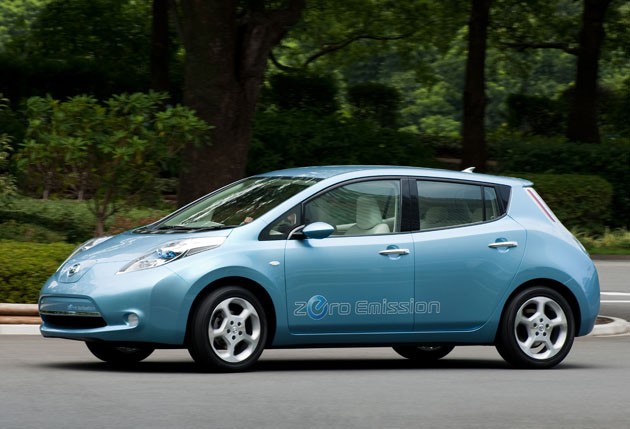
It would be easy to paint Nissan as late to the burgeoning U.S. green party, as the company essentially only counts the Altima Hybrid to sell among its alt-fuel offerings – and that sedan utilizes technology borrowed from Toyota, and it's only sold in a few states in small volumes. While that may be the case, Nissan says their near-term prospects are really quite different. While the company has admittedly been cautious in marketing alt-fuel vehicles in North America, they have been hard at work developing electric vehicles – as well as the advanced lithium-ion batteries to support them – since 1992. What's more, officials say they are now singularly well-placed to leapfrog "transitional" powertrain solutions like gas-electric hybrids in favor of genuine zero-emissions vehicles, and they are promising that their first pure-electric car will reach U.S. shores late next year.
That car, the Nissan Leaf shown here, is the reason we find ourselves in the company's brand-new Yokohama headquarters today. Designed as a four-to-five seat, front-drive C-segment hatchback, Nissan says the Leaf is not just for use as a specialty urban runabout, but rather, it was designed as an everyday vehicle – a "real car" whose 160-kilometer+ (100 mile) range meets the needs of 70% of the world's motorists. In the case of U.S. consumers, Nissan says that fully 80% of drivers travel less than 100km per day (62 miles), making the Leaf a solid fit for America's motoring majority, even taking into account power-sapping external factors like hilly terrain, accessory draw, and extreme temperatures.
We were afforded an advance look at the Leaf ahead of the car's unveiling today, and while it was a hands-off affair, we did have the chance to formulate some in-the-metal first impressions and take a deep dive into the car's technology. Click through to the jump to learn all about it.
That car, the Nissan Leaf shown here, is the reason we find ourselves in the company's brand-new Yokohama headquarters today. Designed as a four-to-five seat, front-drive C-segment hatchback, Nissan says the Leaf is not just for use as a specialty urban runabout, but rather, it was designed as an everyday vehicle – a "real car" whose 160-kilometer+ (100 mile) range meets the needs of 70% of the world's motorists. In the case of U.S. consumers, Nissan says that fully 80% of drivers travel less than 100km per day (62 miles), making the Leaf a solid fit for America's motoring majority, even taking into account power-sapping external factors like hilly terrain, accessory draw, and extreme temperatures.
We were afforded an advance look at the Leaf ahead of the car's unveiling today, and while it was a hands-off affair, we did have the chance to formulate some in-the-metal first impressions and take a deep dive into the car's technology. Click through to the jump to learn all about it.
2012 Cadillac SRX comes with new 3.6L direct-injected V6 engine
A new 308-horsepower 3.6L direct-injected V6 engine gives SRX the most standard power in its class, and includes a driver-selectable ECO Mode for optimal fuel economy. The 2012 Cadillac SRX carries a standard price of $36,060 including $875 destination charge. Other upgrades and changes in the SRX for 2012 include standard Bluetooth on all models, an optional heated steering wheel, a xenon Blue Metallic exterior paint option that will be available in fall 2011, an all-ebony interior option with contrasting stitching, and a new 20-inch wheel finish option.
SRX features an advanced All Wheel Drive system with electronic limited slip rear differential that distributes power front-to-rear, and also can move power across the rear axle based on driving conditions and traction. The chassis includes Adaptive Real-Time damping technology for excellent ride control. Rainsense automatic windshield wipers connect to the braking system, enabling the brakes to conduct slight periodic caliper applications, keeping rotors dry for optimal stopping power in wet conditions.
BMW M1
The premium compact BMW 1-Series is already synonymous with driving pleasure. Now, the second generation offers state-of-the-art engine and suspension technology, further improvements in fuel efficiency, significantly more space and an innovative range of features and equipment. Still the only rear-wheel-driven car in its class, it builds on the strengths of its predecessor, which has already sold more than one million units worldwide. With its outstanding handling and design, innovative technology and premium image, the new BMW 1-Series has consolidated its position as a pioneering individualist in the competitive five-door segment.
BMW's entry-level model has achieved maturity, offering an even better balance between sportiness and driving comfort, improved functionality, and numerous driver assistance systems previously available only in higher segments. This is also apparent in its size. The body of the new BMW 1-Series is 85 millimetres longer than its predecessor, at 4,324 millimetres, while the wheelbase has widened by 30 millimetres to 2,690 millimetres. The car also looks more powerful because its overall width has increased by 17 millimetres to 1,765 millimetres (due to an increase in track of 51 millimetres at the front and 72 millimetres at the rear), whereas its height remains unchanged at 1,421 millimetres. The rear seats have 21 millimetres more legroom, and the luggage compartment has expanded by 30 litres to 360 litres.\
The design of the new generation is a powerful expression of the latest technological advances. The model's fresh, youthful image has been stylishly updated, with precision-moulded body surfaces and a modern, functional interior both underlining its premium status. Another innovation is the BMW Sport Line and BMW Urban Line, two ranges of interior and exterior design features and equipment that provide exclusive personalization opportunities.
BMW's entry-level model has achieved maturity, offering an even better balance between sportiness and driving comfort, improved functionality, and numerous driver assistance systems previously available only in higher segments. This is also apparent in its size. The body of the new BMW 1-Series is 85 millimetres longer than its predecessor, at 4,324 millimetres, while the wheelbase has widened by 30 millimetres to 2,690 millimetres. The car also looks more powerful because its overall width has increased by 17 millimetres to 1,765 millimetres (due to an increase in track of 51 millimetres at the front and 72 millimetres at the rear), whereas its height remains unchanged at 1,421 millimetres. The rear seats have 21 millimetres more legroom, and the luggage compartment has expanded by 30 litres to 360 litres.\
The design of the new generation is a powerful expression of the latest technological advances. The model's fresh, youthful image has been stylishly updated, with precision-moulded body surfaces and a modern, functional interior both underlining its premium status. Another innovation is the BMW Sport Line and BMW Urban Line, two ranges of interior and exterior design features and equipment that provide exclusive personalization opportunities.
Jaguar XKR-S
Making its debut at the 2011 Geneva Motor Show, the Jaguar XKR-S is the most extreme expression yet of Jaguar's passion for building beautiful, fast cars. For the first time with a series production car, Jaguar gains entry to the exclusive '300kph club' thanks to the effortless performance of the supercharged 5.0-litre AJ-V8 engine. A revised fuelling map means the direct-injection powerplant now produces 550PS and 680Nm of torque. Extensive recalibration has ensured that power delivery and performance are seamless, contributing to a 0-60mph time of 4.2 seconds. The Performance active exhaust encourages and rewards the enthusiastic driver with dramatic, motorsport-inspired aural feedback.
The Jaguar XKR-S is not merely the quickest Jaguar ever but also the most agile, responsive and driver-focused. The pinnacle of the XK range builds on feedback gathered from the supercharged XKR and has been developed to extend the performance parameters of the car. This new harder-edged character allows the enthusiastic driver to explore the outer limits of the car's dynamics without losing the refinement and usability for which Jaguar is famous. The structural integrity of the lightweight aluminium platform allowed the suspension to be reworked with bespoke components for increased stiffness without a commensurate loss in either refinement or Jaguar's legendary ride comfort. A reworked aluminium front suspension knuckle and revised rear geometry are allied to stiffer springs and dampers, lightweight forged alloy wheels and recalibrated steering effort to minimise any response delays and produce a more connected and agile driving experience.
Tuesday, July 19, 2011
Chevrolet Cruze Hatchback
The story of the Chevrolet Cruze goes from strength to strength with the latest chapter heralding the launch of a new Chevrolet Cruze hatchback model, further evidence of Chevrolet's intention to bring value for money to all mainstream segments in Europe.
A show car version of Chevrolet's compact contender will be seen for the first time at the 2010 Paris Motor Show, on September 30. It will be one of four world Chevrolet premieres at the show.
With the introduction of the new Chevrolet Cruze hatchback, customers have an alternative body style to the traditional sedan and Chevrolet has raised the bar again with a vehicle that brings new levels of value against some of the more established competition.
According to Wayne Brannon, president and managing director of Chevrolet Europe, the potential for meeting further customer demand is significant. "Cruze is turning out to be a real success story. We are selling it in 70 countries around the world and it has recently surpassed the Aveo as our top selling passenger car nameplate globally.
"Hatchbacks play a critical role in many markets. The total compact segment in Europe represents around 4.8 million units which is over a quarter of the total market, with hatchbacks representing around 65% of that volume. We therefore expect to see increased business in a number of regions, while sending out a signal that Chevrolet is now a serious mainstream player in Europe."
Since its launch in the spring 2009, the Chevrolet Cruze sedan has been warmly welcomed by markets all over the world, greeted as a step change for the brand with customers attracted to its coupe style, build quality, 5-star NCAP rating and driving dynamics. It was also elected the AUTOBEST car of 2010 by a jury of leading auto writers in Central and Eastern Europe.
The Chevrolet Cruze is a car particularly well suited to European driver tastes, a fact borne out by sales success across many of markets. So far in 2010, Chevrolet Cruze tops the compact sedan sales charts in many of the larger European markets including Denmark, Germany, Switzerland, Italy, Spain, Portugal and the U.K., where it is exceeding forecasted sales.
Outside of Europe, Chevrolet Cruze's sales momentum is equally evident. In China alone, Chevrolet has sold nearly 90,000 Cruze since the start of the year, while the sedan is also selling well in Russia, parts of South America, and in India and other emerging markets.
Hatchback design
With its attractive sweeping coupe roofline and short overhangs at both the front and rear, the new Chevrolet Cruze hatchback has the same dynamic 'stance' as the sedan and will be instantly recognizable. It will benefit too from the same taut body 'feel' on the road, being built using the new body-frame integral system (BFI) which is complemented by the final tuning to chassis components. The BFI system results in high levels of stability and solidity.
Cargo capacity for the Chevrolet Cruze hatchback is close to 400 liters and will feature 60/40 split rear seating.
Chevrolet's participation in the World Touring Car Championship with the Chevrolet Cruze is also currently paying great dividends. With four races left in the season, it currently leads both the drivers' and team championships while also showcasing the dynamic qualities of the car to great effect.
The new Chevrolet Cruze 5-door hatchback will go on sale across Europe mid 2011 with prices announced nearer the launch date.
A show car version of Chevrolet's compact contender will be seen for the first time at the 2010 Paris Motor Show, on September 30. It will be one of four world Chevrolet premieres at the show.
With the introduction of the new Chevrolet Cruze hatchback, customers have an alternative body style to the traditional sedan and Chevrolet has raised the bar again with a vehicle that brings new levels of value against some of the more established competition.
According to Wayne Brannon, president and managing director of Chevrolet Europe, the potential for meeting further customer demand is significant. "Cruze is turning out to be a real success story. We are selling it in 70 countries around the world and it has recently surpassed the Aveo as our top selling passenger car nameplate globally.
"Hatchbacks play a critical role in many markets. The total compact segment in Europe represents around 4.8 million units which is over a quarter of the total market, with hatchbacks representing around 65% of that volume. We therefore expect to see increased business in a number of regions, while sending out a signal that Chevrolet is now a serious mainstream player in Europe."
Since its launch in the spring 2009, the Chevrolet Cruze sedan has been warmly welcomed by markets all over the world, greeted as a step change for the brand with customers attracted to its coupe style, build quality, 5-star NCAP rating and driving dynamics. It was also elected the AUTOBEST car of 2010 by a jury of leading auto writers in Central and Eastern Europe.
The Chevrolet Cruze is a car particularly well suited to European driver tastes, a fact borne out by sales success across many of markets. So far in 2010, Chevrolet Cruze tops the compact sedan sales charts in many of the larger European markets including Denmark, Germany, Switzerland, Italy, Spain, Portugal and the U.K., where it is exceeding forecasted sales.
Outside of Europe, Chevrolet Cruze's sales momentum is equally evident. In China alone, Chevrolet has sold nearly 90,000 Cruze since the start of the year, while the sedan is also selling well in Russia, parts of South America, and in India and other emerging markets.
Hatchback design
With its attractive sweeping coupe roofline and short overhangs at both the front and rear, the new Chevrolet Cruze hatchback has the same dynamic 'stance' as the sedan and will be instantly recognizable. It will benefit too from the same taut body 'feel' on the road, being built using the new body-frame integral system (BFI) which is complemented by the final tuning to chassis components. The BFI system results in high levels of stability and solidity.
Cargo capacity for the Chevrolet Cruze hatchback is close to 400 liters and will feature 60/40 split rear seating.
Chevrolet's participation in the World Touring Car Championship with the Chevrolet Cruze is also currently paying great dividends. With four races left in the season, it currently leads both the drivers' and team championships while also showcasing the dynamic qualities of the car to great effect.
The new Chevrolet Cruze 5-door hatchback will go on sale across Europe mid 2011 with prices announced nearer the launch date.
Subscribe to:
Posts (Atom)